Showing posts with label World Future Society. Show all posts

Saturday, August 6, 2016

Foresight Signals: Futurists March on Washington: WFS, PSFN, APF, WFR, and more


Vol. 2, No. 10 | August 2016 | AAI Foresight


As partisan politics and its inherent short-termism vacated Washington, D.C., for the summer, futurists found an opportune time and place for thinking together about thinking ahead.

The main attraction for this brief Summer of Futuring was the World Future Society's summit (July 22-24), with approximately 530 total attendees. Also conferring in D.C. were the Public Sector Foresight Network, the Association of Professional Futurists, and members of the editorial board of World Future Review, the publication formerly serving professional members of the World Future Society and now edited by James Dator for Sage Publications. Other venerable futures institutions on the scene included The Millennium Project, led by Jerome C. Glenn, and TechCast Global, led by William Halal.

Julie Friedman Steele with Kimbal Musk. Photo by C.G. Wagner


Worldfuture 2016 marked the World Future Society's 50th anniversary with the introduction of board chair Julie Friedman Steele.as the new (interim) executive director. Steele made herself visible and accessible to conference goers throughout the event, serving as host and principal discussant for all the keynote presentations: space entrepreneur Bob Richards, co-founder and CEO of Moon Express; poet Sekou Andrews; restauratur and food activist Kimbal Musk; animal rights leader Wayne Pacelle, president and CEO of the Humane Society of the United States; and MacArthur Foundation managing director Cecilia Conrad, who described the 100&Change grant initiative.

In the “box of chocolates” that is the WFS conference, sometimes you really do know what you're going to get. Attendees flocked to such popular speakers as the family of Future Hunters, Edie Weiner, Jared Weiner, and Erica Orange; techno-philosopher and futurist Gray Scott of Serious Wonder; and deans of the Futures School, Kedge partners Frank Spencer and Yvette Montero Salvatico.

One predictable aspect of the conference was the frustration generated by multiple sessions being scheduled concurrently, and the tightly packed meeting rooms were also hard to discreetly escape to sample other sessions.
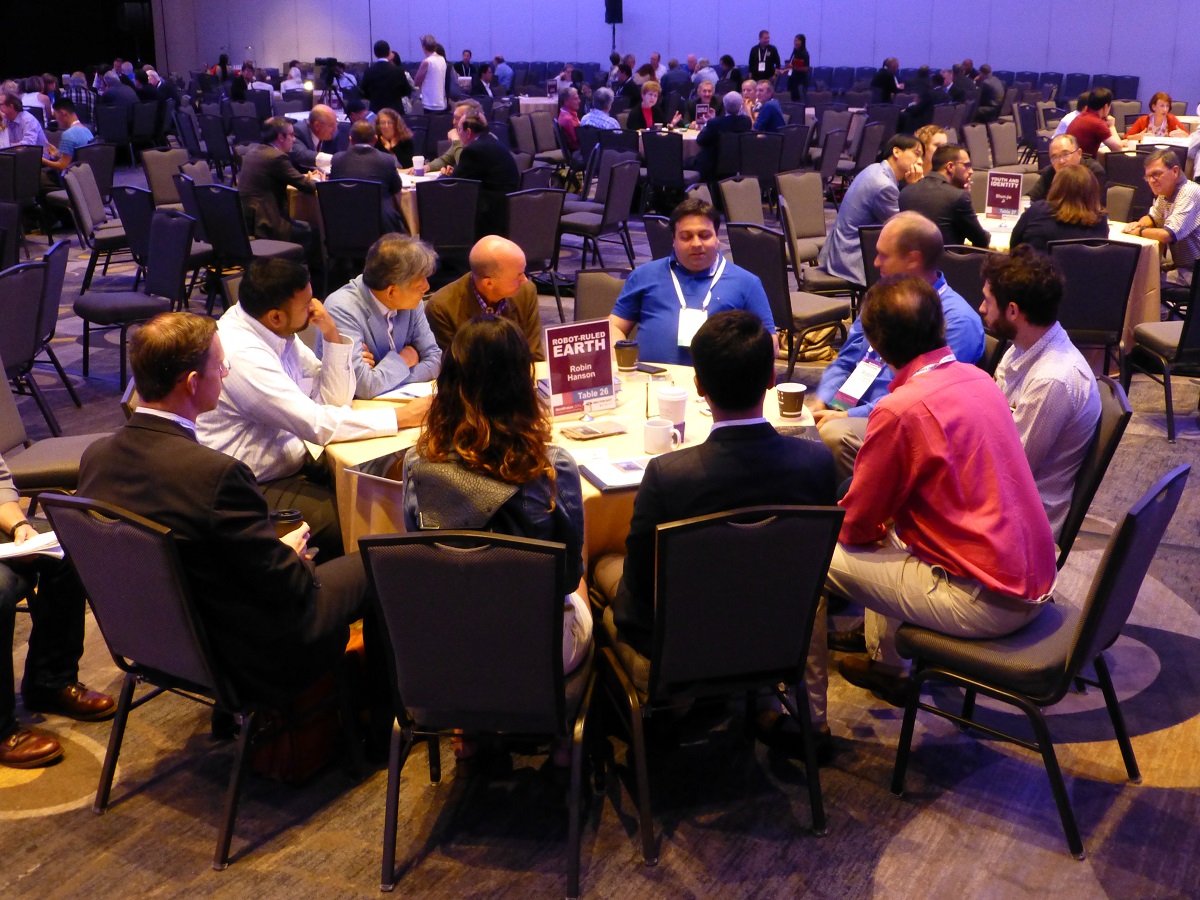
The "unconference" in action. Photo by C.G. Wagner


An innovative solution to the concurrent session scheduling problem was the introduction of an “unconference” format—essentially a cross between poster sessions and roundtable discussions, wherein presenters had their own tables for 90 minutes and could chat more informally with a small group of participants.

Session Sampler

Twenty-One Trends for the Twenty-First Century: Gary Marx, president of the Center for Public Outreach, based his presentation on his new book of the same title, which surveys broad trends in demography, technology, the environment, the economy, and global relations, as well as how these trends will be affected by big data, geriatrics, neuroscience, nano/biotech, security, robotics, the share economy, the gig economy, DIY, the Internet of Things, drones, and more. Many opportunities may be found at the convergence of two or more trends, he said.

The Learning Revolution: Parminder K. Jassal of the ACT Foundation and Katherine Prince and Jason Swanson of KnowledgeWorks presented a variety of emerging paradigms for learning and education. For example, individuals could use the blockchain technology underlying Bitcoins to keep track of their learning experiences and submit their achievements to school systems for credit or to employers as a credential for employment. The blockchain will keep track of classroom experiences as well as on-the-job experiences that qualify for learning. This is a step away from central control of education toward individualized learning, the speakers claimed.

The Age of Illumination: The Coming Revolution in Discovery, Innovation, and Productivity: Deborah Wince-Smith, president and CEO of the U.S. Council on Competitiveness, outlined the variety of ways in which the new technologies will unleash new powers in the future—and unleash tsunamis of data that will double every two years. Increasingly cheap mobile computing empowers us to handle this flood of data, she said, transforming retailing, public health, agriculture, and disaster response.

The Future of Work: Journalist, HR consultant, and lifelong futurist Alexandra Levit offered an overview of trends shaping the future of work relationships. The declining birthrate in the developed world is leading to talent shortages that will lead to the “rise of the seniors, take two,” she said. It will also require the large cohort of millennials to move into leadership positions a decade earlier than their elders did. Levit also disputed the notion that job losses are due to automation; rather, new technologies have generated more opportunities. The social media manager, for instance, is a category that didn't exist 20 years ago. Look for more occupations requiring human skills, such as interpreting big data.

Emotional Machines: On the subject of human-computer relations, Richard Yonck of Intelligent Future Consulting reminded attendees that “emotion was our first interface,” and to work effectively with our technological partners, we need to make our machines more like ourselves than the other way around.

Public foresight programs: Several speakers offered overviews of their initiatives in applying futurism in public agencies, including Aaron Bazin and Mehmet Kinaci on NATO's Framework for Future Alliance Operations; Steven Gale on the U.S. Agency for International Development's Global Development Lab; Byeongwon Park on the Center for Strategic Foresight at South Korea's Science and Technology Policy Institute; Peter Padbury on Policy Horizons Canada; Prabhat Ranjan on India's Technology Information, Forecasting and Assessment Council; Leon Fuerth, director of the Project on Forward Engagement (and former national security adviser to Al Gore); the U.S. Marine Corps Warfighting Lab's Futures Directorate, represented by Patrick Kirchner, Jesse Cook, and James Trahan; and Kira Hutchinson on the U.S. Army's Mad Scientist initiative to explore the operational environment of 2030-2050.

Photo by C.G. Wagner


The future of WFS: Two back-to-back sessions gave attendees an overview of the private member network that replaces The Futurist magazine as the organization's principal membership benefit. While moderator and board member Deborah Peacock tried to steer the discussion toward chapter development, participants at the first of the two mirror sessions pressed for more details on the benefits WFS is now offering. Many expressed concern about the lack of a publication to distribute to prospective members as a recruitment tool, noting that The Futurist had always been an  "ambassador” for the Society.

Peacock emphasized that the suspension of the magazine was a financial decision and that the new WFS—whose membership now numbers “almost 3,000,” according to membership concierge Abby Tang—is very much in a formative stage. Peacock encouraged all members to provide feedback and ideas.

Note: Shortly after the conference, WFS announced a fundraising campaign to pursue a number of member-generated ideas, including “bring back The Futurist.”


Public Sector Foresight Network


Also drawing nearly 100 foresight professionals to D.C. was a meeting July 22 that joined the international Public Sector Foresight Network (PSFN) and the U.S. Federal Foresight Community of Interest (FFCoI). The goal of the joint meeting was to “share knowledge on best practices in identifying emerging trends and discuss issues such as how foresight can be incorporated into decision making,” according to PSFN co-founder Nancy Donovan of the U.S. Government Accountability Office. “Both networks decided to combine forces to organize a joint meeting in 2016 in order to facilitate the exchange of diverse views and best practices by U.S. and international foresight officials.”

The participants shared their experiences bringing foresight work to their government agencies, including a strategic foresight project for the U.S. Environmental Protection Agency, a work technology study for the Basque Country, and work toward formulating an aspirational component for meeting Sustainable Development Goals.

A more detailed report on the meeting prepared by Lane Jennings will be posted on the AAI Foresight Signals blog.


Association of Professional Futurists


Also meeting ahead of the WFS conference July 22 were members of Association of Professional Futurists, who held their annual professional development program. Although AAI Foresight did not attend personally, we enjoyed following the event on Twitter (and hearing the praises of attendees reporting back to us during the WFS conference).

A few tweets:

Andy Hines @futurist_Ahines: @profuturists Opening session on "purpose" followed w/ Jim Dator's amazing futurist journey; always fascinating to learn why we do futures!
Maree Conway @MareeConway: Recurring theme at APF #pro2016 is need to have people and their needs at centre of our work; appeared in many ways today #4futr
Jennifer McDougall @mcdougalljennie: Can design thinking make you a more innovative and effective futurist? #prodev16
APF @profuturists: Breakout sessions: identifying needs over wants, values & beliefs, responding to feedback #ProDev16 #4futr
APF @profuturists: Breakout sessions: consulting through multiple perspectives & operating environments #ProDev16 #4futr
APF @profuturists: Breakout sessions: content must prompt inquiry, curiosity and response. Medium is (still) message #ProDev16 #4futr
incognito sum @incognitosum: Futures & futurists can't be separated from theories of social change @jimdator speaking at @profuturists #ProDev16
Maree Conway @MareeConway: Talking about prediction - big data helps you predict the future for the next 30 seconds Jim Data #prodev16
Christopher Bishop @chrisbishop: #prodev16 #4futr @profuturist put #futurist on your passport so you can have a teachable moment with a border guard/customs official
APF @profuturists: It is always the duty of futurists to think about what's next, to be able to talk about what could be vs what's expected @jimdator #ProDev16
Marti Ryan @martifuturist: @pinnovation "Strategic planning is a waste of time in an era of disruption. Use strategy as a process of learning" #prodev16
Marti Ryan @martifuturist: Super grateful for the opp to bump brains w @profuturists #prodev16. The energy, thinking, leading & creativity continue to inspire me.


World Future Review Editorial Board

Several members of WFR's editorial board also met informally over breakfast during the WFS conference: Antonio Alonso Concheiro, Guillermina Baena Paz, Guillermina Benavides Rincon, Clem Bezold, Stuart Candy, Jay Gary, Jerry Glenn, Fabienne Goux-Baudiment, Sirkka Heinonen, Andrew Hines, Lane Jennings, Claire Nelson, and Wendy Schultz.
Editor Jim Dator solicited ideas and fielded concerns from participants over the logistics of publishing the journal independently of WFS and in digital form only. He announced that the title of the journal would soon be changed to World Futures Review to emphasize the multiplicity of futures studies, and to indicate that the publication was no longer affiliated with the World Future Society.
Dator explained that SAGE’s strategy of bundling online subscriptions to social science journals (of which WFR is one) made past and current issues available through several thousand university library systems worldwide, and that the publisher had no objection to authors using their articles in books or for other purposes provided they did not simply copy the text exactly as it had appeared online.
Suggestions for changes and improvements in the journal were many but uniformly positive. Everyone present applauded Dator’s achievement in getting the journal back on schedule, and agreed with his goal of featuring articles about the field of futures studies itself and not possible futures for society or some specific aspect of it.

One goal that several of those present stressed was to get WFR recognized as an accredited journal, which would allow articles published there to count toward academic tenure. Exactly how this might be achieved is not clear, but the topic will certainly be pursued in future discussions.


Acknowledgments

Thank you to Clem Bezold, James Dator, Nancy Donovan, Jay Herson, and Lane Jennings for their contributions to this report. --CGW
__________

Send us your signals! News about your work and other tips are welcome, as is feedback on Foresight Signals. Contact Cynthia G. Wagner, consulting editor.

Want more signals from AAI Foresight? Check out the blog! Log in to add comments.

Feel free to share Foresight Signals with your networks and to submit any stories, tips, or “signals” of trends emerging on the horizon that we can share with other stakeholders and the foresight community.

__________

© 2016 AAI Foresight

Foresight Signals is a publication of AAI Foresight

1619 Main Street, #1172
Freeland, WA 98249

Managing Principal: Timothy C. Mack
tcmack333@gmail.com | 202-431-1652

Webmaster and IT Consultant: Tom Warner

Consulting Editor: Cynthia G. Wagner

Designer: Lisa Mathias


Saturday, April 9, 2016

Secretary of the Future ... $100 Trillion Toilet Paper ... and more

Vol. 2, No. 6 | April 13, 2016 | AAI Foresight


News for the Foresight Community

> Hot Topic: Secretary of the Future?
> Relaunches: World Future Society, Communities of the Future
> Blog Report: $100 Trillion Toilet Paper
> Mack Report: More Services, Fewer Jobs?


Hot Topic: Secretary of the Future?


Recently on American Public Media’s Marketplace, David Brancaccio and Katie Long picked up on the late Kurt Vonnegut’s what-if scenario of a cabinet-level futurist. Vonnegut had fretted, “I'll tell you ... one thing that no Cabinet has ever had is a Secretary of the Future, and there are no plans at all for my grandchildren and my great grandchildren.”

Image: Alle / Flickr

The idea, Brancaccio and Long infer, is “to help politicians think harder about how today’s actions might play out in 10, 20, 50 years.” This is a well-established activity in many corporations, such as Intel, where former futurist-in-residence Brian David Johnson’s role included presenting to the decision makers “a future that really wasn’t quite rosy because the company needed to be prepared for that.”

Taking issue with such a proposal is Reason magazine’s science columnist (with solid futurist credentials of his own), Ronald Bailey: “My quick answer,” he writes, “It's a really stupid idea. Human beings are terrible at foresight, and it would be especially terrible to try [to] marry our purblind premonitions to government power.”

Bailey provides an overview of the U.S. government’s predictive failures since the 1970s, suggesting that, unlike businesses, government forecasters bear no real consequences for getting things wrong: “But if a private company gets its forecasts wrong, the worst that happens is that it goes out of business and is replaced by competitors who made the right calls. Markets are superb at marshaling vast quantities of information, and they amply reward foresight and good guesses,” Bailey writes. “The problem with government planning is government power.”

Returning to the idea of a Secretary of the Future, however, let’s look at another possibility: that foresight in government would not be about power or prediction, but about ongoing cross-agency and cross-sector discussions of possible futures and their consequences. This was the basis for such foresight-oriented government entities as the Congressional Office of Technology Assessment, the Congressional Clearinghouse on the Future, and then-Senator Al Gore Jr.’s 1990 proposal for a White House-based office to study critical trends. (“The Critical Trends Assessment Act: Futurizing the United States Government,” The Futurist, March-April 1990.)

Former Gore adviser Leon Fuerth outlined such a scenario of ongoing futures discussions in a 2013 article for The Futurist. Fuerth and co-author Evan Faber described ways for government workers below the cabinet level and across agencies to confer and inform each other on emerging trends and their potential consequences—thus fulfilling the goal of  helping “politicians think harder about how today’s actions might play out in 10, 20, 50 years.”

Comment: Shortly after his inauguration, President George W. Bush spoke at a trade association dinner I attended. During the meet-and-greet, I was able to blurt out a challenge to the new president: “We’d like to see more foresight in government!” He responded, without irony: “So would I. It would be a miracle.” —CGW

Sources:  David Brancaccio and Katie Long, “What  If We Had a Secretary of the Future?” Marketplace, posted March 1, 2016. Ronald Bailey, “A U.S. Department of the Future Is a Really Bad Idea,” Reason, posted March 18, 2016.

Reference: Leon Fuerth and Evan Faber, “Anticipatory Governance: Winning the Future,” The Futurist, July-August 2013. PDF available on request.

Image: Alle/Flickr (Creative Commons).

Signals: foresight, futurists, government


Relaunches: World Future Society, Communities of the Future


Two venerable futures organizations have recently relaunched themselves, with new missions and new websites:

* World Future Society, http://www.wfs.org, founded in 1966 by Edward Cornish, invites futurists to “Be a part of our ambitious and exciting plans as we build a community of future-focused leaders who connect across the globe and explore areas of shared interest.” The Society's annual conference this year, themed “A Brighter Future IS Possible,” will serve as a 50th anniversary summit on the organization's future. (Signal courtesy of Jerome C. Glenn.)


* Communities of the Future, http://communitiesofthefuture.org/, founded in 1989 by Rick Smyre, unites futurists at the local level to share visions and resources to actively manage the multifaced changes affecting their communities. As Smyre steps away from being the central driver of COTF's activities, he invites friends and colleagues to participate in building COTF 2.0. (Signal courtesy of Peter Bishop.)


Blog Report: $100 Trillion Toilet Paper


In January 2009, Zimbabwe issued its largest-denomination bank note, a one-hundred-trillion-dollar bill. Soon after, it was not enough to buy a single square of bathroom tissue.

The hyperinflation Zimbabwe was experiencing is an example of a wild card—a low probability, high impact event or condition. Unfortunately, writes environmental futurist David N. Bengston, traditional planning typically focuses on continuous change rather than on potentially life-altering events. In the case of Zimbabwe's hyperinflation, life savings were wiped out, real assets were hoarded, and foreign investment evaporated.

“On the plus side,” Bengston notes, “hyperinflation is good for people who are in debt because they can pay it off with worthless cash. But a complete breakdown of the economy is a steep price to pay for clearing your debt!”

Read: “The Strange Case of the Hundred Trillion Dollar Toilet Paper” by David N. Bengston, Foresight Signals Blog, posted April 1, 2016.

Signals: economics, inflation, wild cards, Zimbabwe


More Services, Fewer Jobs? AI and Automation's Impacts

By Timothy C. Mack

Research and development in artifical intelligence and automation may focus on solving human problems or on developing machine learning; both focuses have potential impacts on creating or eliminating jobs.

On issues of agency, the researchers ask what problems need to be solved and how can AI or robotics solve them. For example, in the delivery of health services, how do you reach remote locations where costs are too high for the lowest income populations? Perhaps digital response and assessment can save lives where human doctors are not available or practical. Similarly, in elementary school settings with insufficient availability of human teachers, could a responsive program serve to tutor struggling students in a personalized way? In these examples, the digital agency is shaped so that the AI function is specific-task oriented.

The other side of this coin is the focus on machine learning, such as by the Google DeepMind project. Its most recent deep learning approaches are self-structured—that is, they are not preprogrammed. The 2015 Deep Q project let a reinforcement-learning program teach itself how to play older Atari video games, with the result that it not only learned very quickly but it surpassed the game creators in developing unique strategies. In this setting, the agency was intentionally independent and somewhat unbounded (except for the focus on video games).  Accordingly, the focus is expansion of AI learning capability (general intelligence).

So the question becomes how these two paths will affect the course of work worldwide in the future. And the clear answer is the old saw, “It’s complicated.” This means that outcomes will be shaped by the dialogues between these viewpoints: targeted problem solving and general capacity building. The spread between these viewpoints is driven not so much by Luddite fears of job replacement by the grandchild of automation in some form of thinking versus acting, but instead by more elemental fears of species replacement with AI as the next and better generation (whether it be augmented humans or digital avatars). It is very likely that both concerns about unbounded AI independence and the drive for efficiency and effectiveness will produce a mix of outcomes as we move forward.

Not only will AI continue to replace humans in many areas, but we will also see digital agents of all sorts assisting humans in areas such as law, medicine, journalism, and so on to improve outcomes. Medical services to groups and regions not served before, reductions in traffic fatalities from assisted-driving software, and better legal representation in an always high-stress field are among many examples ahead.

How we'll manage the cultural and policy impacts is more a political and social question than a technical one, but the policy issues are making themselves felt through the AI R&D world as well. The result, as it plays out, will be fascinating.

Timothy C. Mack is managing principal of AAI Foresight Inc.

Signals: AI, artificial intelligence, automation, education, jobs, work


__________

Send us your signals! News about your work and other tips are welcome, as is feedback on Foresight Signals. Contact Cynthia G. Wagner, consulting editor.

Want more signals from AAI Foresight? Check out the blog! Log in to add comments.

Feel free to share Foresight Signals with your networks and to submit any stories, tips, or “signals” of trends emerging on the horizon that we can share with other stakeholders and the foresight community.

__________

© 2016 AAI Foresight

Foresight Signals is a publication of AAI Foresight

1619 Main Street, #1172
Freeland, WA 98249

Managing Principal: Timothy C. Mack
tcmack333@gmail.com | 202-431-1652

Webmaster and IT Consultant: Tom Warner

Consulting Editor: Cynthia G. Wagner

Designer: Lisa Mathias


Sunday, January 31, 2016

Foresight Signals: End of Coal? ... "Planetary Futurist" ... WFS Transition ... and more


News for the Foresight Community


> Hot Topic: The End of Coal?
> Futurists in the News: Alex Steffen
> Publications: Lifeboat Books
> In Transition: World Future Society
> In Memoriam: Maurice Strong
> Blog Report: Self-Driving Cars and Wild Nature


Hot Topic: The End of Coal?


About a dozen years ago, energy policy analyst Barbara Freese warned in her groundbreaking book, Coal: A Human History, that our use of coal would one day be condemned by future generations and that all of coal’s contributions to the industrial development we’ve come to enjoy and take for granted would be overshadowed by the predicted drastic climate changes.

While responses to Freese’s recommendation that “we move quickly and aggressively toward climate-friendly energy sources” have arguably been neither quick nor aggressive, signs of the end of our dependence on coal (and our vulnerability to its unhealthy impacts) are emerging.

Recent data from the Institute for Energy Economics and Financial Analysis show that China’s slowing economy and its move away from heavy industry toward services are dragging down demand for coal; both domestic coal production and imports have declined, and the government has announced it “will not approve any new coal mine projects for the next three years and will close down a thousand small mines,” reports Tim Buckley, IEEFA’s director of energy finance studies, Australasia. As a result, “China’s total country emissions are on track to peak potentially a decade earlier than their official target of no later than 2030.” Meanwhile, China is ramping up its investments in wind, solar, hydro, and nuclear production.

In the United States, where renewable and efficient energy investment is about half that of China ($56 billion in 2015 versus China’s $110 billion), coal is nevertheless on a downward trend, with “a 10 percent year-over-year decline in coal consumption in 2015 (and down already a staggering 29.7 percent so far in 2016) in addition to a three-year moratorium of new federal coal leases,” Buckley reports.

As one sign of the times, utilities in Oregon have agreed to phase out coal-fired plants by 2030 and to double the amount of renewable energy they generate by 2040. The measures are popular with Oregon voters—and have united some seemingly unlikely partners, Pacific Power spokesman Scott Bolton told Oregon Public Broadcasting. “Some of these folks we’ve never worked with before, so it is actually exciting to find some common interests,” he said. “You don’t see PacifiCorp and Sierra Club on the same letterhead very often.”

References: Coal: A Human History by Barbara Freese (Penguin, 2003).

Data Bite: China Continues to Drive Global Markets Lower” by Tim Buckley, Institute for Energy Economics and Financial Analysis, January 18, 2016.

Oregon Utilities Agree to Phase Out Coal-Fired Power” by Cassandra Profita, OPB/EarthFix, January 6, 2016.

Image: Steve Buissinne / Pixabay (Creative Commons license)

Signals: alternative energy, China, climate change, coal, Oregon, utilities


Futurists in the News: Alex Steffen


“Planetary futurist” Alex Steffen, author of Worldchanging and Carbon Zero, was one of a handful of non-tech innovators in the San Francisco Bay area profiled on the blog The Bold Italic. (Also profiled for the piece were a chef, a distiller, and a singer.) The article describes Steffen’s work as “environmentalism to the core but goes beyond, requiring a complete rethinking of how humanity engages with the environment” and Steffen as the kind of innovator needed “to guide us through the hazy, tough road ahead.” Read:Four Standout Bay Area Innovators Who Aren’t in Technology” by Ronny Kerr, The Bold Italic, January 15, 2016.


Publications: Lifeboat Books


The Lifeboat Foundation published three new books of fiction and nonfiction at the end of 2015. Visions of the Future, edited by J. Daniel Batt, features stories and essays on artificial intelligence, androids, life extension, and more, including contributions from Ray Kurzweil, David Brin, and Martin Rees. Prospects for Human Survival, by theoretical physicist Willard Wells, argues that technological advances may be accelerating faster than our ability to control them, suggesting that humanity should develop friendly superhuman AI as quickly as possible. The third edition of The Human Race to the Future: What Could Happen—and What to Do by Daniel Berleant also was released. Details: Lifeboat Foundation Books.


In Transition: World Future Society


In a recent announcement to members, World Future Society board chair and Interim Executive Director Julie Friedman Steele said she would be conducting a listening tour over the next few weeks to share thoughts on the future direction of the Society. With the endorsement of founder Edward Cornish and his family, WFS will hold its 2016 annual meeting July 22-24 in Washington, D.C. The conference will take the form of a summit and celebration of the Society’s 50th anniversary. WFS headquarters are now at 1875 Connecticut Ave., N.W., 10th Floor, Washington, D.C. 20009. Download FAQs and profiles of Steele and the current WFS board of directors (PDFs).


In Memoriam: Maurice Strong


Maurice F. Strong, secretary general of the UN Conference on Environment and Development, died November 30 at the age of 86. Perhaps best known as the organizer of the 1992 Rio Earth Summit, Strong was a longtime World Future Society board member and was on the Society’s Global Advisory Council through 2014. He shared his thoughts on “Reforming the United Nations” in the September-October 2001 issue of The Futurist.

“Maurice Strong was a unique voice at the World Future Society, with senior leadership experience in both the Canadian power industry and UN environmental programs, thus bridging the gap between public and private,” said former WFS President Timothy Mack, managing principal of AAI Foresight. “He also advised the UN on such delicate matters as the Korean Peninsula and China’s changing role in the world (living in Beijing for many years). He was consulted right up until his death as an expert on multilateralism and peaceful resolution of conflicts and enjoyed a high profile in the Rio and Rio+20 world environmental conferences. Strong was instrumental in promoting government funding and entry into international meetings for environmental NGOs for over 40 years.”


Blog Report: Self-Driving Cars and Wild Nature


As autonomous and semiautonomous vehicles gain powers and popularity, one potential impact has received scant attention. In his latest blog for AAI Foresight, environmental futurist David N. Bengston warns that proponents need to look beyond the first-order effects of these technologies.

“Natural systems near roads are degraded by an increased abundance of invasive species, reduced carbon sequestration, severed wildlife corridors, and spillover effects as people clear newly accessible forests and drain wetlands,” Bengston writes.

Read:Self-Driving Cars and Wild Nature” by David N. Bengston, Foresight Signals Blog (January 2016).

Signals: automobiles, highways, nature, self-driving cars, sprawl, wilderness

__________

Send us your signals! News about your work and other tips are welcome, as is feedback on Foresight Signals. Contact Cynthia G. Wagner, consulting editor. 

Want more signals from AAI Foresight? Check out the blog! Log in to add comments.

Feel free to share Foresight Signals with your networks and to submit any stories, tips, or “signals” of trends emerging on the horizon that we can share with other stakeholders and the foresight community.

__________

© 2016 AAI Foresight

Foresight Signals is a publication of AAI Foresight

1619 Main Street, #1172
Freeland, WA 98249

Managing Principal: Timothy C. Mack
tcmack333@gmail.com | 202-431-1652

Webmaster and IT Consultant: Tom Warner

Consulting Editor: Cynthia G. Wagner

Designer: Lisa Mathias