Showing posts with label AI. Show all posts

Friday, May 12, 2017

Getting Ready (or Not) for Future Jobs, a Summer of Futuring, and Moves in the Field


Vol. 3, No. 7 | May 2017 | AAI Foresight


Hot Topic: Future Jobs—Or Not

The Pew Research Center [http://www.pewresearch.org/] has released the results of its survey of technologists, scholars, practitioners, strategic thinkers, and education leaders on the future of workplace training in the next decade. More than 1,400 participants responded to the survey, which Pew conducted with Elon University’s Imagining the Internet Center [http://www.elon.edu/e-web/imagining/] in summer 2016.

In addition to addressing how disruptive technologies such as IT, AI, automation, and robotics may develop, Pew asked respondents to focus on the potential disruptions these technologies may have on capitalist systems and particularly on jobs.

While a narrow majority (52 percent) of the respondents said technological advances will create more jobs than they destroy, that doesn’t mean things will be easy for tomorrow’s human workers. For the 30 percent of respondents expressing pessimism about people’s prospects in a tech-dominated economy, a major concern is how people will meet their basic needs and the impacts of these needs on economic systems.

Credit: Geralt/Pixabay 
If, as Microsoft researcher Jonathan Grudin says, “People will create the jobs of the future, not simply train for them,” education and learning will need to adapt to new priorities. Human skills that will be required include creativity, collaboration, abstract thinking, complex communication, and social and emotional intelligence. But, Pew reports, about “a third of respondents expressed no confidence in training and education evolving quickly enough to match demands by 2026.”

Among the recommendations for adapting education and learning was to emulate the environments human learners already exist in, such as those of gaming and social media. Psychologist and futurist Dana Klisanin of Evolutionary Guidance Media R&D, wrote, “Educational institutions that succeed will use the tools of social media and game design to grant students’ access to teachers from all over the world and increase their motivation to succeed.… Online educational programs will influence the credentialing systems of traditional institutions, and online institutions will increasingly offer meet-ups and mingles such that a true hybrid educational approach emerges.”

The bottom line, according to AAI Foresight’s Timothy C. Mack, is that, “In the area of skill-building, the wild card is the degree to which machine learning begins to supplant social, creative and emotive skill sets.”

Read “The Future of Jobs and Jobs Training” [http://www.pewinternet.org/2017/05/03/the-future-of-jobs-and-jobs-training/] by Lee Rainie and Janna Anderson, Pew Internet (May 3, 2017).

art credit: Geralt/Pixabay


Europe’s Summer of Futuring

Futures-oriented groups across Europe are planning events in conjunction with the Antwerp Museum of Contemporary Art’s exhibition “A Temporary Futures Institute” [https://www.muhka.be/programme/detail/660-a-temporary-institute-of-futures-studies] running through the end of September. Organized by Agence Future, [http://www.agencefuture.org/] the events include:

Humankind 2050, June 7-10, Jondal, Norway. The World Futures Studies Federation’s [https://www.wfsf.org/] annual meeting, themed “Peace, Development, Environment,” seeks to “envision, design and work towards creating peaceful, ecological and equitable futures for humankind for the next fifty years and beyond.” The event also marks the 50th anniversary of the Mankind 2000 meeting in Oslo, which “put futures research on the global map” and led to WFSF’s formation. Details at the WFSF conference page. [https://www.wfsf.org/our-activities/wfsf-conferences/22nd-wfsf-world-conference-june-7-10-2017]

Futures of a Complex World, June 12-13, Turku, Finland. Celebrating its 25th anniversary of academic research, the Finland Futures Research Centre at the University of Turku is holding its 18th international futures conference, organized in cooperation with the Finland Futures Academy, the National Foresight Network, Finland, and Foresight Europe Network. Among the keynote speakers will be John L. Casti of The X-Center. Details at the center’s conference page. [https://futuresconference2017.wordpress.com/ ]

Design - Develop - Transform, June 15-17, Brussels and Antwerp, Belgium. Organized by the knowledge center Applied Futures Research-Open Time and the Museum of Contemporary Art of Antwerp, this event invites academic and professional futurists from around the world to look at how futures are designed, developed, and transformed. Teach the Future [http://www.teachthefuture.org/] and the Association of Professional Futurists [https://apf.org/] are co-creating content for this “unconference,” and Jim Dator, founder of the Hawaii Research Center for Futures Studies, [http://www.futures.hawaii.edu/] will be the keynote speaker. APF will also conduct a professional development day workshop during the event. Details at the conference page. [https://ddtconference.org/]


Moves in the Field

James Dator is retiring as director of the Hawaii Research Center for Futures Studies. [http://www.futures.hawaii.edu/] He will be succeeded by Jarius Grove, who is on sabbatical until summer 2017.

Jamais Cascio [http://www.openthefuture.com/jamais_bio.html] was awarded an honorary doctorate from the University of Advancing Technology in Tempe, Arizona. “The technologies and tools we make are as much artifacts of our culture as artifacts of our science,” Cascio said. “What a technology means—its social utility, its ethical footprint, its role in our lives—increasingly matters as much or more than what a technology does.” Watch UAT’s commencement, featuring Cascio’s speech, online. [http://www.uat.edu/commencement

Maria H. Andersen is co-founder and CEO of Coursetune Inc. [http://coursetune.com/] She was previously director of learning design at Western Governors University.

Marco Bevolo, PhD, is a member of the editorial board of the journal Research in Hospitality Management. [https://www.ajol.info/index.php/rhm] He is also partner, foresight and design thinking, at Amati & Associates. [www.amati-associates.com] He was previously research principal at Philips.

Michael Lissack is chair of Vistage Worldwide Inc. [http://www.vistage.com/]

Manjul Rathee is senior service designer at Shift - Product design for social change. [http://www.shiftdesign.org.uk/]. She was previously service designer at Mind of My Own.


Recent Publications

Always Tomorrow Now,” [https://doi.org/10.1177/1946756717697336]an interview with Luiz Alberto Oliveira (Museum of Tomorrow) by Stuart Candy, World Futures Review [http://journals.sagepub.com/home/wfr] (March 2017). Opening in Rio de Janeiro in December 2015, Museu do Amanhã (the Museum of Tomorrow) received more than a million visitors in its first nine months. In this article, museum fellow Candy interviews curator Oliveira, exploring the “the story and thinking behind a cultural institution of foresight dedicated to questions rather than answers, experiences rather than artifacts, and multiple possible futures rather than an unalterable past.” See discussions, stats, and author profiles for this publication at ResearchGate. [https://www.researchgate.net/publication/313391057]

Anybody out there? The Future of Tax” [http://jfsdigital.org/2016-2/vol-21-no-2-dec-2016/articles/anybody-out-there-the-future-of-tax/] by Gitte Heij (Melbourne University Law School), Journal of Futures Studies (December 2016), 21(2): 35–50. This paper uses the Three Horizons model of analysis, exploration, and futures imagination to consider “possible futures for raising tax revenue in an environment of rapidly evolving technology, automation, globalization, the rising power of powerful interest groups, and the trend of increased accumulation of wealth in the hands of fewer taxpayers.”


Special Offer: Futuristic Education Archives

In celebration of his 80th birthday (May 11) Arthur Shostak, emeritus professor of sociology, Drexel University, is offering to share many of the educational items he has collected since learning about futuristics as an undergraduate in the 1950s.

The materials available include books, magazines, and academic articles “of continued value in the study of the probable, possible, preferable, and preventable future.” He only requests reimbursement for shipping costs. If interested, contact him at arthurshostak@gmail.com.


In Memoriam

Robert William Taylor, 85, computer networking pioneer whose early work in the 1960s as director of the Information Processing Techniques Office at the Advanced Research Projects Agency is credited as a significant contribution to the development of the Internet. Read more in the New York Times. [https://www.nytimes.com/2017/04/14/technology/robert-taylor-innovator-who-shaped-modern-computing-dies-at-85.html?_r=0]

Donald Kitchell Conover, 85, a former vice president of corporate education for AT&T who led the Corporate Education Center at Princeton. He was also a member of the World Future Society, among many professional and civic organizations. Read more in the Bucks County Courier Times. [http://www.buckscountycouriertimes.com/obituaries/bcct/donald-kitchell-conover/article_47075802-bf12-5903-8c58-207703a44296.html]

__________


Send us your signals! News about your work and other tips are welcome, as is feedback on Foresight Signals. Contact Cynthia G. Wagner, consulting editor.

Want more signals from AAI Foresight? Check out the blog! Log in to add comments.
Feel free to share Foresight Signals with your networks and to submit any stories, tips, or “signals” of trends emerging on the horizon that we can share with other stakeholders and the foresight community.

__________

© 2017 AAI Foresight

Foresight Signals is a publication of AAI Foresight
1619 Main Street, #1172
Freeland, WA 98249

Managing Principal: Timothy C. Mack
tcmack333@gmail.com | 202-431-1652

Webmaster and IT Consultant: Tom Warner

Consulting Editor: Cynthia G. Wagner

Designer: Lisa Mathias

Sunday, January 31, 2016

Foresight Signals: End of Coal? ... "Planetary Futurist" ... WFS Transition ... and more


News for the Foresight Community


> Hot Topic: The End of Coal?
> Futurists in the News: Alex Steffen
> Publications: Lifeboat Books
> In Transition: World Future Society
> In Memoriam: Maurice Strong
> Blog Report: Self-Driving Cars and Wild Nature


Hot Topic: The End of Coal?


About a dozen years ago, energy policy analyst Barbara Freese warned in her groundbreaking book, Coal: A Human History, that our use of coal would one day be condemned by future generations and that all of coal’s contributions to the industrial development we’ve come to enjoy and take for granted would be overshadowed by the predicted drastic climate changes.

While responses to Freese’s recommendation that “we move quickly and aggressively toward climate-friendly energy sources” have arguably been neither quick nor aggressive, signs of the end of our dependence on coal (and our vulnerability to its unhealthy impacts) are emerging.

Recent data from the Institute for Energy Economics and Financial Analysis show that China’s slowing economy and its move away from heavy industry toward services are dragging down demand for coal; both domestic coal production and imports have declined, and the government has announced it “will not approve any new coal mine projects for the next three years and will close down a thousand small mines,” reports Tim Buckley, IEEFA’s director of energy finance studies, Australasia. As a result, “China’s total country emissions are on track to peak potentially a decade earlier than their official target of no later than 2030.” Meanwhile, China is ramping up its investments in wind, solar, hydro, and nuclear production.

In the United States, where renewable and efficient energy investment is about half that of China ($56 billion in 2015 versus China’s $110 billion), coal is nevertheless on a downward trend, with “a 10 percent year-over-year decline in coal consumption in 2015 (and down already a staggering 29.7 percent so far in 2016) in addition to a three-year moratorium of new federal coal leases,” Buckley reports.

As one sign of the times, utilities in Oregon have agreed to phase out coal-fired plants by 2030 and to double the amount of renewable energy they generate by 2040. The measures are popular with Oregon voters—and have united some seemingly unlikely partners, Pacific Power spokesman Scott Bolton told Oregon Public Broadcasting. “Some of these folks we’ve never worked with before, so it is actually exciting to find some common interests,” he said. “You don’t see PacifiCorp and Sierra Club on the same letterhead very often.”

References: Coal: A Human History by Barbara Freese (Penguin, 2003).

Data Bite: China Continues to Drive Global Markets Lower” by Tim Buckley, Institute for Energy Economics and Financial Analysis, January 18, 2016.

Oregon Utilities Agree to Phase Out Coal-Fired Power” by Cassandra Profita, OPB/EarthFix, January 6, 2016.

Image: Steve Buissinne / Pixabay (Creative Commons license)

Signals: alternative energy, China, climate change, coal, Oregon, utilities


Futurists in the News: Alex Steffen


“Planetary futurist” Alex Steffen, author of Worldchanging and Carbon Zero, was one of a handful of non-tech innovators in the San Francisco Bay area profiled on the blog The Bold Italic. (Also profiled for the piece were a chef, a distiller, and a singer.) The article describes Steffen’s work as “environmentalism to the core but goes beyond, requiring a complete rethinking of how humanity engages with the environment” and Steffen as the kind of innovator needed “to guide us through the hazy, tough road ahead.” Read:Four Standout Bay Area Innovators Who Aren’t in Technology” by Ronny Kerr, The Bold Italic, January 15, 2016.


Publications: Lifeboat Books


The Lifeboat Foundation published three new books of fiction and nonfiction at the end of 2015. Visions of the Future, edited by J. Daniel Batt, features stories and essays on artificial intelligence, androids, life extension, and more, including contributions from Ray Kurzweil, David Brin, and Martin Rees. Prospects for Human Survival, by theoretical physicist Willard Wells, argues that technological advances may be accelerating faster than our ability to control them, suggesting that humanity should develop friendly superhuman AI as quickly as possible. The third edition of The Human Race to the Future: What Could Happen—and What to Do by Daniel Berleant also was released. Details: Lifeboat Foundation Books.


In Transition: World Future Society


In a recent announcement to members, World Future Society board chair and Interim Executive Director Julie Friedman Steele said she would be conducting a listening tour over the next few weeks to share thoughts on the future direction of the Society. With the endorsement of founder Edward Cornish and his family, WFS will hold its 2016 annual meeting July 22-24 in Washington, D.C. The conference will take the form of a summit and celebration of the Society’s 50th anniversary. WFS headquarters are now at 1875 Connecticut Ave., N.W., 10th Floor, Washington, D.C. 20009. Download FAQs and profiles of Steele and the current WFS board of directors (PDFs).


In Memoriam: Maurice Strong


Maurice F. Strong, secretary general of the UN Conference on Environment and Development, died November 30 at the age of 86. Perhaps best known as the organizer of the 1992 Rio Earth Summit, Strong was a longtime World Future Society board member and was on the Society’s Global Advisory Council through 2014. He shared his thoughts on “Reforming the United Nations” in the September-October 2001 issue of The Futurist.

“Maurice Strong was a unique voice at the World Future Society, with senior leadership experience in both the Canadian power industry and UN environmental programs, thus bridging the gap between public and private,” said former WFS President Timothy Mack, managing principal of AAI Foresight. “He also advised the UN on such delicate matters as the Korean Peninsula and China’s changing role in the world (living in Beijing for many years). He was consulted right up until his death as an expert on multilateralism and peaceful resolution of conflicts and enjoyed a high profile in the Rio and Rio+20 world environmental conferences. Strong was instrumental in promoting government funding and entry into international meetings for environmental NGOs for over 40 years.”


Blog Report: Self-Driving Cars and Wild Nature


As autonomous and semiautonomous vehicles gain powers and popularity, one potential impact has received scant attention. In his latest blog for AAI Foresight, environmental futurist David N. Bengston warns that proponents need to look beyond the first-order effects of these technologies.

“Natural systems near roads are degraded by an increased abundance of invasive species, reduced carbon sequestration, severed wildlife corridors, and spillover effects as people clear newly accessible forests and drain wetlands,” Bengston writes.

Read:Self-Driving Cars and Wild Nature” by David N. Bengston, Foresight Signals Blog (January 2016).

Signals: automobiles, highways, nature, self-driving cars, sprawl, wilderness

__________

Send us your signals! News about your work and other tips are welcome, as is feedback on Foresight Signals. Contact Cynthia G. Wagner, consulting editor. 

Want more signals from AAI Foresight? Check out the blog! Log in to add comments.

Feel free to share Foresight Signals with your networks and to submit any stories, tips, or “signals” of trends emerging on the horizon that we can share with other stakeholders and the foresight community.

__________

© 2016 AAI Foresight

Foresight Signals is a publication of AAI Foresight

1619 Main Street, #1172
Freeland, WA 98249

Managing Principal: Timothy C. Mack
tcmack333@gmail.com | 202-431-1652

Webmaster and IT Consultant: Tom Warner

Consulting Editor: Cynthia G. Wagner

Designer: Lisa Mathias

Tuesday, April 14, 2015

Signals: Living in (Smart) Glass Houses... and more

Vol. 1, No. 12 | April 16, 2015 | AAI Foresight

Inside Foresight Signals

> Living in a (Smart) Glass House
> Food Regulators Urged to Define “Natural”
> Marketing for a Better World: Report from Timothy C. Mack
> In Memoriam: Kenneth W. Harris

Living in a (Smart) Glass House


Colder winters and hotter summers are why living and working in glass-fronted buildings is not smart. These beautiful but energy-inefficient designs are costly for owners and waste tremendous amounts of energy.

Buildings account for a huge portion of overall energy consumption—some 40 percent in Germany, for instance. Fraunhofer Institute researchers in Dresden are now working with students and professors at Weissensee School of Art in Berlin to develop better materials for use in glass façades.

The team is constructing a demonstration model of thermally reactive fabric blinds based on a concept by design student Bára Finnsdottir. The design consists of a matrix of 72 flowerlike fabric components with shape-memory actuators integrated into them. As sunlight hits the façade, the pieces move noiselessly to shield the building from heat.

The researchers hope to have a commercially available system by mid-2017. Looking beyond smarter façades, they envision even better energy capabilities for the concept.

“It might be possible to store solar thermal energy and then release it when needed to heat the interior, for instance at night,” says André Bucht, department head at Fraunhofer IWU. “Another idea is to coat the flower fabric components with malleable, organic solar cells in order to generate electricity that can be used within the building.”

Source: Fraunhofer IWU. Image: © Bára Finnsdóttir, Weissensee School of Art Berlin.

Signals: architecture, design, energy


Food Regulators Urged to Define “Natural”


Food producers, consumers, and regulators all want to know what’s natural, and no one seems to agree. “Artificial” ingredients are a little easier to understand, such as added colors and flavors, but these additives cast suspicions on many food products that may actually be harmless.

With more genetically modified organisms creeping into the food supply, marketers have been put on the defensive to reassure consumers and regulators. Consumers have resorted to lawsuits to demand complete and accurate information on the stuff they stuff into their mouths.

“Though natural food lawsuits to date have disappointed, they encourage marketers to drop the claim of being natural or reformulate their products to avoid future lawsuits,” writes Ross D. Petty of Babson College in the Journal of Public Policy & Marketing. “Perhaps this will persuade the [Food and Drug Administration] or [Federal Trade Commission] to consider creating, finally, a definition for the meaning of natural.”


Reference: Ross D. Petty, “‘Natural’ Claims in Food Advertising: Policy Implications of Filling the Regulatory Void with Consumer Class Action Lawsuits,” Journal of Public Policy & Marketing (In Press). DOI:10.1509/jppm.14.147 

Signals: consumers, food, GMO, marketing, regulation


Marketing for a Better World: Report from Timothy C. Mack


Psychology, behavioral economics, and even neuroscience are coming together with digital technology to change the mechanics of human decision making. The goal is to use feedback on consumers’ emotional reactions and to apply conditioning techniques (rewards) to promote the habits of pleasurable actions. Behavior engineering is flowering in such developments as Nir Eyal’s Habit Hook, driven by rapid advances in neuroscience and the emergence of continuous shopping.

But this approach isn’t just about reinforcing habitual consumption; it could also build habits that are actually good for you, such as encouraging more physical activity, getting more rest each night, or being more frugal. Nonprofit organizations could also use such benign behavior building techniques, benefiting from greater sharing of personal information and higher, more reactive transmissions speeds worldwide. Read more.

Timothy C. Mack is managing principal of AAI Foresight Inc. This report is adapted from the Foresight Signals blog. Download his Foresight Report “The Future of Retail Marketing” (Spring 2015).

Signals: addiction, AI, marketing, neuroscience, psychology

In Memoriam: Kenneth W. Harris


The foresight community was saddened to learn of the death earlier this year of Ken Harris, who served the World Future Society and its National Capital chapter for many years. He was also a field editor on transportation for TechCast Global and a member of the Association for Professional Futurists and the Lifeboat Foundation, in addition to his work as a consultant for the Consilience Group.

Ken was an avid sports and fitness fan, enjoying golf, biking, weight training, and numerous other activities, about which he wrote eloquently for The Futurist.

“His interests and expertise ranged from transportation to the sports industry to health, and worked on fundraising and outreach programs,” said AAI Foresight managing consultant Tim Mack. “He was diligent, reliable and indefatigable in his support of the interests of the World Future Society, and he will be greatly missed.”

Ken devoted more than 30 years to federal civil service, working principally at the Federal Aviation Administration. His work in helping the FAA navigate the future of aviation and the economy segued to his post-federal consulting and volunteer work, including leading book discussion groups.

“Ken Harris was among the most dedicated World Future Society volunteers relentlessly advocating for and actively supporting the activities of the futures community,” said former board chair Ken Hunter. “He worked tirelessly to support the WFS chapters and people around the world developing local groups. He also served on many special project teams always contributing time, talent and professionalism to enterprise. It was a pleasure serving with Ken over the decades.”

Ken lived in Bethesda, Maryland, with his wife, Carolyn. At the time of this writing, a date for memorial services had not been set. Condolences may be posted in the comments here or emailed to AAI Foresight and will be forwarded to Carolyn Harris.


Send us your signals! News about your work and other tips are welcome. Contact Cynthia G. Wagner, consulting editor.  

Want more signals from AAI Foresight? Check out the blog! Log in to add comments.

Feel free to share Foresight Signals with your networks and to submit any stories, tips, or “signals” of trends emerging on the horizon that we can share with other stakeholders and the foresight community. And if you’re interested in becoming a blogger for FS, please contact Cindy Wagner, our consulting editor, at CynthiaGWagner@gmail.com


© 2015 AAI Foresight

Foresight Signals is a publication of AAI Foresight

1619 Main Street #1172
Freeland, WA 98249

Managing Principal: Timothy C. Mack
tcmack333@gmail.com | 202-431-1652

Webmaster and IT Consultant: Tom Warner

Consulting Editor: Cynthia G. Wagner
 

Sunday, April 12, 2015

Marketing for a Better World

By Timothy C. Mack

While I have written in the past about the revolution that the world of retail is undergoing, one interesting thing about the future is that it keeps unfolding. Like any lively crossroads of converging technologies, the principles of retail choice (or should I say persuasion) brings psychology, behavioral economics, and even neuroscience together with digital technology to change the mechanics of human decision making.

Wiring the face muscles of subjects viewing Internet websites (looking for irritation from frowning or delight from smiling) is rather old hat, but what is new is using this feedback data to build habitual behavior out of the pleasure data, based on the half-century-old research of B.F. Skinner on positive conditioning. The goal is to transform the subject’s initial actions into to compelling urges to repeat pleasurable actions.

Nir Eyal is the developer of an approach called the Habit Hook, a progressive learning loop that begins with an action trigger, leading to a rewarding experience and ending with some sort of investment. The result is an increased likelihood that the subject will undertake the whole sequence again, thus moving smoothly from actions into urges.

What is most provocative about this new integration of the soft and hard sciences
(which increasingly involves smartphones and a wider range of apps than simple online retail) is that it could build habits that are actually good for you, such as increased participation in corporate wellness programs by encouraging not just more activity but more rest each night.


This arena is now being crowded not just by decision psychologists, but also by game theorists and predictive modelers. While better services and more suitable offers for consumers are hyped, what we are seeing is a brave new world for advertising. Firms like Rocket Fuel, are using AI programming to design ideal website ads that make upwards of $400 million annually. This is a long way from putting the “next best thing” into that Web stream to see if it went viral or faded away, with few clues of what the outcome would be.

Behavior engineering is flowering, driven by rapid advances in neuroscience and the emergence of continuous shopping. The constantly evolving Web is no longer an impediment to choice but a process of galvanization and inside information rewards (newest and best first); consumer participants will soon be able to continuously curate their commercial experiences, thereby educating both themselves and marketers.

Note: This is not a lament about our loss of personal freedom or psychic privacy (although that may be increasingly involved). It is an observation that positive behaviors such as healthier activity or increased frugality are also the outcomes of habit building. Moreover, nonprofit organizations could also use such benign behavior building techniques, benefiting from greater sharing of personal information and higher, more reactive transmissions speeds worldwide.

If activating the brain’s reward circuitry is “addiction,” whether or not substance abuse is involved, as the American Society of Addiction Medicine has determined, these techniques may cause concerns. But they also may suggest solutions to some of society’s most concerning health and public safety challenges.

Timothy C. Mack is managing principal of AAI Foresight Inc. Image: Steve Jurvetson, Flickr.

DownloadThe Future of Retail Marketing” by Timothy C. Mack, Foresight Report, AAI Foresight Inc., Spring 2015 (PDF).

Sources:Technology and Persuasion” by Nanette Byrnes and “Compulsive Behavior Sells” by Ted Greenwald in MIT Technology Review Business Report: Paths of Persuasion, March 23, 2015. 

Thursday, January 29, 2015

Signals: Minor Infections, Major Problems... Waterless Recycling... Autonomous Autos... and more


Vol. 1, No. 7 | February 2, 2015 | AAI Foresight 

Inside Foresight SIGNALS

> Minor or Hidden Infections May Accelerate Mortality
> Dry Innovation for Plastics Recycling
> Liability and the Self-Driving Car: Report from Timothy Mack
> Scholarly Researchers Embrace Skepticism
> Futurists and Foresight in the News

Minor or Hidden Infections May Accelerate Mortality


If you escaped that horrific flu or other infection that’s been going around in your neighborhood, school, or workplace, you may count yourself lucky. Maybe you only got a mild infection, or felt well and kept on working just as effectively as ever. The bad news is that such hidden or mild, untreated infections could be shortening your life.

In studies of migratory birds with mild malaria infections, researchers at Sweden’s Lund University discovered that the cumulative effects of chronic infections shortened the birds’ telomeres—the caps on chromosomes that protect DNA—accelerating the aging process.

“The small, non-measureable effects of the chronic disease appear to underlie the accelerated shortening of the telomeres. When the telomeres get too short, this has a fatal effect and causes premature death,” said Lund researcher Dennis Hasselquist of the Department of Biology, a member of the research team. “If this is a general mechanism for any type of mild, chronic infection, which is quite possible, it will mean our study is of major interest to understand the impact that mild illnesses can have on other organisms, including humans.”

Reference: M. Asghar, D. Hasselquist, B. Hansson, P. Zehtindjiev, H. Westerdahl, S. Bensch, “Hidden costs of infection: Chronic malaria accelerates telomere degradation and senescence in wild birds,” Science (January 23, 2015), Vol. 347, No. 6220, pp. 436-4381. DOI: 10.1126/science.1261121 

Signals: aging, health, longevity, telomeres


Dry Innovation for Plastics Recycling


Water-intensive processes for recycling plastic waste could one day be replaced with new techniques that don’t require liquids. A dry recycling process developed by Ak Inovex of Mexico also promises to reduce energy consumption, use less space, and cut costs.

Using customizable machinery, the process can work with any type of plastic material, such as Styrofoam and polystyrene, to produce small plastic beads or pellets. Rather than dehydrating the original materials at high heat and then cooling them with water, Ak Inovex uses a patent-pending process of cooling through contact with special walls.

The company now plans to add biodetergents to the cleaning process for the recycled plastic products, thus keeping water use and costs at the lowest possible levels. Ak Inovex was a participant in Cleantech Challenge Mexico, a contest to promote the development of green companies. (See also “Power Pedaling with Bamboo Bike,” Foresight SIGNALS, Vol. 1, no. 6.)

Source: Investigación y Desarrollo [in Spanish].

Signals: green technology, innovation, Mexico, plastics, recycling, water


Liability and the Self-Driving Car: Report from Timothy Mack


The auto industry is clearly convinced that the question of autonomous vehicles is “not if, but when.” But the potential impacts on the industry, such as liability issues, are less clear.

Motor Trend analyst Frank Markus notes a number of relatively clear benefits of a working national autonomous-vehicle system, such as reduced accidents, increased mobility for nondrivers, reduced fuel consumption, and more intelligent driving patterns. 

But one of the most interesting questions regards autonomous and driver-controlled vehicles sharing the same roadways: If there are far fewer accidents, there will still be accidents, but probably fewer insurers to cover them. Who is responsible when accidents happen? Who pays? Rather than owners of autonomous vehicles taking out insurance (and paying premiums), would it fall on manufacturers to indemnify their products?

One possibility is public/private special compensation funds to underwrite unintended consequences. Owners of older, non-autonomous cars might be required to financially subsidize the rollout of presumably safer autonomous vehicles and road systems. Of course, manufacturers’ liability remains a toss-up in any court of law.

Timothy Mack is the managing principal of AAI Foresight Inc. This report was adapted from the Foresight SIGNALS Blog. Image credit: Sam Churchill, via Flickr (Creative Commons license).

Signals: AI, autonomous vehicles, insurance, law, transportation


Scholarly Researchers Embrace Skepticism


A journal devoted to exploring the philosophical concept of skepticism has now been included in Scopus, a database of peer-reviewed literature that covers nearly 22,000 titles by 5,000 publishers worldwide. Scopus offers researchers wide access to tools to facilitate tracking, analysis, and visualization of research.

Brill’s International Journal for the Study of Skepticism, edited by Diego E. Machuca (CONICET, Argentina) and Duncan H. Pritchard (University of Edinburgh), publishes articles and organizes symposiums on all aspects of skeptical thought and current problems, including debates on epistemology, metaethics, and the philosophy of religion, among many other topics.

“The journal is fully committed to the highest standards of clarity and rigor, and serves as a forum for debate and exchange of ideas among leading international philosophers and scholars,” according to its mission statement.

Brill is an international academic publisher based in Lieden, the Netherlands, covering Middle East and Islamic Studies, Asian Studies, Classical Studies, History, Biblical and Religious Studies, Language and Linguistics, Biology, International Law, and more.

Details: Brill press release. Follow @Scopus on Twitter.

Signals: academic publishing, philosophy, research, skepticism


Futurists and Foresight in the News


Global Strategic Foresight Community: The World Economic Forum has established a new future-oriented interest group comprising leaders and stakeholders in government, industry, and the foresight profession. Among the participants are The Art of the Long View author Peter Schwartz of Salesforce.com, The Millennium Project founder Jerome C. Glenn, NATO strategic analyst Stephanie Babst, and Julius Gatune of the African Centre for Economic Transformation. The GSFC will “provide a peer network to compare and contrast insights as well as to positively shape future-related industry, regional and global agendas.” Details 


Survey on New Approaches in Foresight: Futurists around the world often develop new methodologies, which may affect outcomes in their foresight work. To better understand these new approaches and their impacts on science, technology, and innovation policy around the world, particularly Southeast Asia, The Future Impacts Consulting firm invites Foresight SIGNALS readers to participate in a brief survey (deadline February 6). Details: Contact Cornelia Daheim, daheim@future-impacts.de 

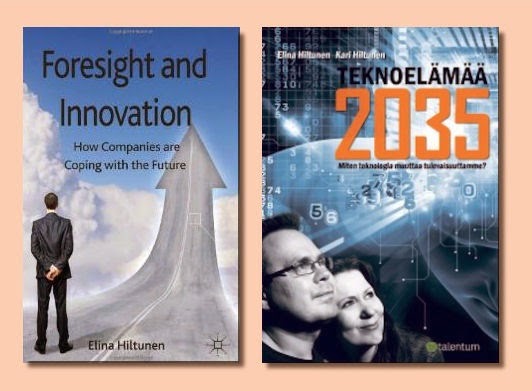
Technolife 2035: The English-language version of Teknoelämää 2035 by Finnish futurists Elina and Kari Hiltunen is now in progress and should be available soon. Elina’s previous book, Foresight and Innovation: How Companies are Coping with the Future, available in both Finnish and English, offers unique foresight tools that she has developed, such as the TrendWiki, Futures Windows, Strategic Serendipity, and the Futuropoly board game. Details 

Earth Policy Institute to Close: Leading environmental policy expert Lester R. Brown has announced his plans to retire from the think tank he founded in 2001. EPI will close by July this year, and the English-language versions of its principal publications will be housed at Rutgers University, Brown’s alma mater, in the new Lester R. Brown Reading Room. Brown’s career, spanning more than half a century, was devoted to measuring the planet’s resources and assessing its well-being, and issuing urgent warnings on such problems as climate change, overpopulation, and unsustainable consumption of resources. Details 


Frances Segraves, Former Futurist Staff Editor: We sadly report the passing of our friend and former colleague, pioneering newspaper journalist Frances Segraves, on January 14. She was 87. Frances was a staff editor for The Futurist magazine and the World Future Society Bulletin, retiring at the end of 1998. Before joining WFS to work with her longtime friends Ed and Sally Cornish, Frances was one of the first female reporters in the 1950s to cover hard news stories, working for The Frederick News, The Baltimore Sun, Bethlehem Globe-Times, and The Washington Star. She was also an activist in the anti-war and civil rights movements in the 1960s and 1970s. Details 


Send us your signals! News about your work and other tips are welcome. Contact Cynthia G. Wagner, consulting editor.  

Want more signals from AAI Foresight? Check out the blog! Log in to add comments.

Feel free to share Foresight SIGNALS with your networks and to submit any stories, tips, or “signals” of trends emerging on the horizon that we can share with other stakeholders and the foresight community. And if you’re interested in becoming a blogger for FS, please contact Cindy Wagner, our consulting editor, at CynthiaGWagner@gmail.com


Foresight SIGNALS is a publication of AAI Foresight

1619 Main Street #1172
Freeland, WA 98249

Managing Principal: Timothy C. Mack
tcmack333@gmail.com | 202-431-1652

Webmaster and IT Consultant: Tom Warner

Consulting Editor: Cynthia G. Wagner