Showing posts with label autonomous vehicles. Show all posts

Saturday, June 10, 2017

Hogs and the Self-Driving Car, Another Futurist at Ford, Moves in the Field, and more


Vol. 3, No. 8 | June 2017 | AAI Foresight


How Autonomous Vehicles Could Affect Hog Farming

From the department of unexpected consequences.... The rise of self-driving cars could alter the future of hog production, Canadian futurist Nikolas Badminton [http://nikolasbadminton.com/] recently told an audience of swine farmers. Reason: Autonomous vehicles will be safer, resulting in fewer deaths and therefore fewer human organs available for donation. Enter the medical pig.

Gene-editing technologies under development could create pigs with organs suitable for use in humans, Badminton said. With the trend toward vegetarianism already affecting demand for pork, hog farmers may instead raise the animals for medical consumption.

Read “Self-driving cars could affect pig production: futurist” [http://www.producer.com/2017/05/self-driving-cars-could-affect-pig-production-futurist/] by Mary Baxter, The Western Producer (May 4, 2017). Note: Badminton has opened a new speakers bureau, Futurist Speaker Agency. [https://futuristspeakersagency.com/]


Ford Hires (Another) Futurist

The Ford Motor Co. praises its new CEO, Jim Hackett, [https://media.ford.com/content/fordmedia/fna/us/en/people/james-hackett.html] as a “visionary” who will help the company move forward in developing autonomous vehicles. Hackett joined Ford in 2016 to lead its mobility services division.

Previously, Ford’s futures-orientation had manifested itself in sustainability efforts such as lightweighting the popular F-150 trucks with aluminum instead of steel. But the vehicles have become so popular that, as more are manufactured, more resources are consumed (including both virgin and recycled materials), points out sustainability scholar Carl A. Zimring in a new book, Aluminum Upcycled.

The most sustainable automobile design of the twenty-first century is not an automobile at all, but a system to distribute transportation services,” Zimring writes. “Automobile-sharing programs such as Zipcar and IGO, and the bicycle-sharing programs of several European and North American cities distribute the services of driving to a wide clientele without the damage of mass production and disposal.”

Comment: If this is what Hackett’s vision is for Ford, and if he can monetize that vision into services Ford can provide, he may truly earn the name of futurist. But Hackett isn’t the first futurist at Ford. It’s actually in Sheryl Connelly’s [https://media.ford.com/content/fordmedia/fna/us/en/people/sheryl-connelly.html] job description. Connelly is the company’s manager for global consumer trends and futuring and has given numerous presentations on futurism in her industry. (Disclosure: This writer owns a few shares of Ford stock and has owned only Ford vehicles since the early 1980s.) —CGW

Read Aluminum Upcycled: Sustainable Design in Historical Perspective by Carl A. Zimring of the Platt Institute (Johns Hopkins University Press [www.press.jhu.edu], 2017).

Credit, Hackett and Connelly photos: Ford Motor Co.


Opportunity: Startups for Smart Cities

The Singularity University has issued a call for startup companies and entrepreneurs “that apply exponential technologies to help shape better cities,” starting with Columbus, Ohio. “In this intensive 10-week program, you’ll receive high-velocity training, relevant mentoring from the best minds around the world, and help preparing to scale your company,” according to SU. “Finally, you’ll also receive up to $100,000 in seed funding, provided by NCT Ventures.” The accelerator will be from September 12 to November 17 in Columbus. The deadline to apply is July 17. Learn more at Singularity University. [https://su.org/smart-city-accelerator/startups/]


Recent Publications

The Future of Britain 2022: A Pre-Election Survey on Electoral Priorities” by Rohit Talwar, Alexandra Whittington, and April Koury, Fast Future Publishing [http://fastfuturepublishing.com/main/] (June 5, 2017).
More than 79 percent of respondents to Fast Future’s survey stated that creating a more representative electoral system was a major priority for the future of Britain, with nearly 28 percent suggesting that decentralizing authority and decision making to the local level would help achieve this goal. “The scale of interest in electoral reform may come as the biggest surprise but is a clear reflection of the desire for more representative governance models,” the report states. And despite the Brexit victory a year ago, nearly 42 percent of the Britons responding to the survey said assuring Britain retains access to the European single market is a priority.

See also Joergen Oerstroem Moeller’s analysis of the recent elections: “Time for UK to practise humility: Tarnished May's unnecessary gamble,” [https://www.omfif.org/analysis/commentary/2017/june/time-for-uk-to-practise-humility/] OMFIF—Official Monetary and Financial Institutions Forum (June 9, 2017). Moeller is senior research fellow, ISEAS Yusof Ishak Institute, and Singapore Management University, and a former state secretary at the Danish Foreign Ministry.

The Internet of Things Connectivity Binge: What Are the Implications?” [http://www.pewinternet.org/2017/06/06/the-internet-of-things-connectivity-binge-what-are-the-implications/] by Lee Rainie and Janna Anderson, Pew Research Center, Internet & Technology (June 6, 2017).

Despite fears of widespread cyberattacks, “The Internet of Things (IoT) is in full flower,” Rainie and Anderson write. This report on Pew’s “nonscientific canvassing” of more than 1,200 IT professionals, futurists, and others found that 85 percent would choose more connectivity rather than less. But we will increasingly be unaware of that connectivity, commented Jamais Cascio, [http://www.openthefuture.com/jamais_bio.html]] distinguished fellow at the Institute for the Future. “Think of it as the ‘electricity’ effect,” he said. On the other hand, “the attacks will get much worse,” said writer Cory Doctorow, co-owner of Boing Boing.

At present, the Internet of Things is more a series of missteps than a grand design, if for no other reason than many of the large players are competitors versus cooperators and accepted protocols are still not agreed upon,” commented Timothy C. Mack, managing principal at AAI Foresight. “As well, the ‘gold rush’ quality of such areas as ‘smart homes’ has led to shoddy design and poor construction of the physical and the digital aspects of this brave new world. As for the loss of critical safety and security through networks trying to interconnect and protect and the same time (with largely the same tools), we should expect many more disappointments in the IoT development saga.”


Moves in the Field

RAND opens Bay Area office: The RAND Corporation has opened on office in San Francisco “to foster collaboration with the region's leaders and researchers working to solve today’s complex problems—issues including technological change and innovation, social inequality, water resource management, and transportation.” Senior information scientist Nidhi Kalra [https://www.rand.org/about/people/k/kalra_nidhi.html] will lead the new office. Learn more at RAND. [https://www.rand.org/blog/2017/04/rand-opens-office-in-the-san-francisco-bay-area.html]

Sweeney joins humanitarian organization: Futurist John A. Sweeney has joined the International Federation of Red Cross and Red Crescent Societies (Geneva, Switzerland) as global futures and foresight coordinator. Learn more at IFRC. [http://ifrc.org/innovation]


Honors and Milestones

XPRIZE names authors to Science Fiction Advisory Council: The XPRIZE will seek inspiration from more than 60 “visionary storytellers who will lend their expertise in honing our vision of the future.” Among those on the council are Margaret Atwood,[http://margaretatwood.ca/] Cory Doctorow, [http://craphound.com/bio/] Madeline Ashby, [http://madelineashby.com/] David Brin, [http://www.davidbrin.com/biography.html] Brenda Cooper, [http://www.brenda-cooper.com/about/] and Greg Bear. [http://www.gregbear.com/bio.php] Learn more at XPRIZE. [http://www.xprize.org/about/scifi]

Silicon Valley Honors Tech Investors: The Silicon Valley Forum has bestowed its annual Visionary Award on five technology investors: DFJ partner Steve Jurvetson; [http://dfj.com/people/steve-jurvetson] IBM nanotechnology pioneer Don Eigler; [https://www.research.ibm.com/theworldin2050/bios-Eigler.shtml] Megan Smith, [https://obamawhitehouse.archives.gov/administration/eop/ostp/about/leadershipstaff/smith] chief technology officer of the United States under the Obama administration; Neri Oxman [https://www.media.mit.edu/people/neri/overview/ ] of the MIT Media Lab; and Linda Rottenberg [http://endeavor.org/global-board/linda-rottenberg/] of Endeavor. Learn more at Silicon Valley Forum. [http://siliconvalleyforum.com/event/29130789977]


In Memoriam

Jacque Fresco: Venus Project founder Jacque Fresco died May 18 in Sebring, Florida, at the age of 101. Like Buckminster Fuller before him, Fresco was a big-picture thinker whose passion was solving the world’s greatest problems, including equitable resource distribution. The Venus Project, set about two hours south of Orlando, Florida, realized his vision, with partner Roxanne Meadows, of a cybernetically sophisticated city featuring elegant, spaceship-like buildings. Read the open letter by Roxanne Meadows

Richard Solomon: RAND Corporation senior fellow Richard H. Solomon died March 13 in Bethesda, Maryland. He was 79. Solomon was a China scholar and is credited with helping open U.S.-China relations and ending conflict in Cambodia. He also led the U.S. Institute of Peace for 19 years, where he helped promote nonviolent conflict resolution. Read the RAND press release [https://www.rand.org/news/press/2017/03/14.html] and the Washington Post obituary. [https://www.washingtonpost.com/world/richard-solomon-kissinger-aide-involved-in-ping-pong-diplomacy-with-china-dies-at-79/2017/03/14/a8866d74-ef03-11e6-b4ff-ac2cf509efe5_story.html?utm_term=.859cfce33c5c]

_________


Send us your signals! News about your work and other tips are welcome, as is feedback on Foresight Signals. Contact Cynthia G. Wagner, consulting editor.

Want more signals from AAI Foresight? Check out the blog! Log in to add comments.
Feel free to share Foresight Signals with your networks and to submit any stories, tips, or “signals” of trends emerging on the horizon that we can share with other stakeholders and the foresight community.

__________

© 2017 AAI Foresight

Foresight Signals is a publication of AAI Foresight
1619 Main Street, #1172
Freeland, WA 98249

Managing Principal: Timothy C. Mack
tcmack333@gmail.com | 202-431-1652

Webmaster and IT Consultant: Tom Warner

Consulting Editor: Cynthia G. Wagner

Designer: Lisa Mathias

Sunday, January 31, 2016

Foresight Signals: End of Coal? ... "Planetary Futurist" ... WFS Transition ... and more


News for the Foresight Community


> Hot Topic: The End of Coal?
> Futurists in the News: Alex Steffen
> Publications: Lifeboat Books
> In Transition: World Future Society
> In Memoriam: Maurice Strong
> Blog Report: Self-Driving Cars and Wild Nature


Hot Topic: The End of Coal?


About a dozen years ago, energy policy analyst Barbara Freese warned in her groundbreaking book, Coal: A Human History, that our use of coal would one day be condemned by future generations and that all of coal’s contributions to the industrial development we’ve come to enjoy and take for granted would be overshadowed by the predicted drastic climate changes.

While responses to Freese’s recommendation that “we move quickly and aggressively toward climate-friendly energy sources” have arguably been neither quick nor aggressive, signs of the end of our dependence on coal (and our vulnerability to its unhealthy impacts) are emerging.

Recent data from the Institute for Energy Economics and Financial Analysis show that China’s slowing economy and its move away from heavy industry toward services are dragging down demand for coal; both domestic coal production and imports have declined, and the government has announced it “will not approve any new coal mine projects for the next three years and will close down a thousand small mines,” reports Tim Buckley, IEEFA’s director of energy finance studies, Australasia. As a result, “China’s total country emissions are on track to peak potentially a decade earlier than their official target of no later than 2030.” Meanwhile, China is ramping up its investments in wind, solar, hydro, and nuclear production.

In the United States, where renewable and efficient energy investment is about half that of China ($56 billion in 2015 versus China’s $110 billion), coal is nevertheless on a downward trend, with “a 10 percent year-over-year decline in coal consumption in 2015 (and down already a staggering 29.7 percent so far in 2016) in addition to a three-year moratorium of new federal coal leases,” Buckley reports.

As one sign of the times, utilities in Oregon have agreed to phase out coal-fired plants by 2030 and to double the amount of renewable energy they generate by 2040. The measures are popular with Oregon voters—and have united some seemingly unlikely partners, Pacific Power spokesman Scott Bolton told Oregon Public Broadcasting. “Some of these folks we’ve never worked with before, so it is actually exciting to find some common interests,” he said. “You don’t see PacifiCorp and Sierra Club on the same letterhead very often.”

References: Coal: A Human History by Barbara Freese (Penguin, 2003).

Data Bite: China Continues to Drive Global Markets Lower” by Tim Buckley, Institute for Energy Economics and Financial Analysis, January 18, 2016.

Oregon Utilities Agree to Phase Out Coal-Fired Power” by Cassandra Profita, OPB/EarthFix, January 6, 2016.

Image: Steve Buissinne / Pixabay (Creative Commons license)

Signals: alternative energy, China, climate change, coal, Oregon, utilities


Futurists in the News: Alex Steffen


“Planetary futurist” Alex Steffen, author of Worldchanging and Carbon Zero, was one of a handful of non-tech innovators in the San Francisco Bay area profiled on the blog The Bold Italic. (Also profiled for the piece were a chef, a distiller, and a singer.) The article describes Steffen’s work as “environmentalism to the core but goes beyond, requiring a complete rethinking of how humanity engages with the environment” and Steffen as the kind of innovator needed “to guide us through the hazy, tough road ahead.” Read:Four Standout Bay Area Innovators Who Aren’t in Technology” by Ronny Kerr, The Bold Italic, January 15, 2016.


Publications: Lifeboat Books


The Lifeboat Foundation published three new books of fiction and nonfiction at the end of 2015. Visions of the Future, edited by J. Daniel Batt, features stories and essays on artificial intelligence, androids, life extension, and more, including contributions from Ray Kurzweil, David Brin, and Martin Rees. Prospects for Human Survival, by theoretical physicist Willard Wells, argues that technological advances may be accelerating faster than our ability to control them, suggesting that humanity should develop friendly superhuman AI as quickly as possible. The third edition of The Human Race to the Future: What Could Happen—and What to Do by Daniel Berleant also was released. Details: Lifeboat Foundation Books.


In Transition: World Future Society


In a recent announcement to members, World Future Society board chair and Interim Executive Director Julie Friedman Steele said she would be conducting a listening tour over the next few weeks to share thoughts on the future direction of the Society. With the endorsement of founder Edward Cornish and his family, WFS will hold its 2016 annual meeting July 22-24 in Washington, D.C. The conference will take the form of a summit and celebration of the Society’s 50th anniversary. WFS headquarters are now at 1875 Connecticut Ave., N.W., 10th Floor, Washington, D.C. 20009. Download FAQs and profiles of Steele and the current WFS board of directors (PDFs).


In Memoriam: Maurice Strong


Maurice F. Strong, secretary general of the UN Conference on Environment and Development, died November 30 at the age of 86. Perhaps best known as the organizer of the 1992 Rio Earth Summit, Strong was a longtime World Future Society board member and was on the Society’s Global Advisory Council through 2014. He shared his thoughts on “Reforming the United Nations” in the September-October 2001 issue of The Futurist.

“Maurice Strong was a unique voice at the World Future Society, with senior leadership experience in both the Canadian power industry and UN environmental programs, thus bridging the gap between public and private,” said former WFS President Timothy Mack, managing principal of AAI Foresight. “He also advised the UN on such delicate matters as the Korean Peninsula and China’s changing role in the world (living in Beijing for many years). He was consulted right up until his death as an expert on multilateralism and peaceful resolution of conflicts and enjoyed a high profile in the Rio and Rio+20 world environmental conferences. Strong was instrumental in promoting government funding and entry into international meetings for environmental NGOs for over 40 years.”


Blog Report: Self-Driving Cars and Wild Nature


As autonomous and semiautonomous vehicles gain powers and popularity, one potential impact has received scant attention. In his latest blog for AAI Foresight, environmental futurist David N. Bengston warns that proponents need to look beyond the first-order effects of these technologies.

“Natural systems near roads are degraded by an increased abundance of invasive species, reduced carbon sequestration, severed wildlife corridors, and spillover effects as people clear newly accessible forests and drain wetlands,” Bengston writes.

Read:Self-Driving Cars and Wild Nature” by David N. Bengston, Foresight Signals Blog (January 2016).

Signals: automobiles, highways, nature, self-driving cars, sprawl, wilderness

__________

Send us your signals! News about your work and other tips are welcome, as is feedback on Foresight Signals. Contact Cynthia G. Wagner, consulting editor. 

Want more signals from AAI Foresight? Check out the blog! Log in to add comments.

Feel free to share Foresight Signals with your networks and to submit any stories, tips, or “signals” of trends emerging on the horizon that we can share with other stakeholders and the foresight community.

__________

© 2016 AAI Foresight

Foresight Signals is a publication of AAI Foresight

1619 Main Street, #1172
Freeland, WA 98249

Managing Principal: Timothy C. Mack
tcmack333@gmail.com | 202-431-1652

Webmaster and IT Consultant: Tom Warner

Consulting Editor: Cynthia G. Wagner

Designer: Lisa Mathias

Saturday, January 23, 2016

Self-Driving Cars and Wild Nature

By David N. Bengston

People have been thinking and dreaming about self-driving cars for a long time. Paleofuture.com’s article about the “Driverless Car of the Future” (Novak 2010) features a 1957 magazine ad depicting a family playing Scrabble in a bubble-topped car as it cruises down a six-lane freeway, the steering wheel pointedly unattended. The ad copy reads in part, “One day your car may speed along an electric super-highway, its speed and steering automatically controlled by electronic devices embedded in the road. Highways will be made safe—by electricity! No traffic jam … no collisions … no driver fatigue.”

Self-driving cars are, of course, no longer a futuristic idea. Virtually every car company is working on them, along with tech companies such as Google (now Alphabet) and Apple. More and more self-driving features are available in cars today. They’re coming, and sooner than many of us think. A recent Business Intelligence report (Greenough 2015) forecasts 10 million autonomous vehicles on the roads by 2020, some semiautonomous and some fully autonomous.

The first-order impacts of autonomous vehicles will be to transform transportation and mobility. Other travel-related industries will be among the first to feel the effects. For example, self-driving cars could reduce the need for short-haul domestic flights, hotels, and car rentals as travelers sleep en route and have their own cars at the destination (dezeen 2015).

But self-driving vehicles will also have many unintended higher-order impacts. In his book Future Ride, technology writer Peter Wayner identifies scores of ways in which every aspect of society will be affected (Wayner 2015). The lengthy subtitle of Wayner’s book points to a few of these impacts: “99 Ways the Self-Driving, Autonomous Car Will Change Everything from Buying Groceries to Teen Romance to Turning Ten to Having a Heart Attack ... to Simply Getting from Here to There.”

A likely higher-order consequence of self-driving cars that has received little attention is their impacts on natural areas. The effects could be profound. One possibility is that the comforts and efficiencies of self-driving cars may result in much longer commutes and more sprawling development. If you can eat your breakfast, watch the news, surf the Web, catch up on your reading, do some work, or take a nap on your commute, you may live farther out in undeveloped areas. Self-driving cars may reduce the need for roads in cities, but they could induce more road building and low-density development in remote areas.

Roads create serious environmental impacts (Haddad 2015). Natural systems near roads are degraded by an increased abundance of invasive species, reduced carbon sequestration, severed wildlife corridors, and spillover effects as people clear newly accessible forests and drain wetlands. The net effect is a loss of wild nature much greater than just the area of the road’s path, and a resulting loss of life-supporting ecosystem services.

The consequences of road-building and cars have been a concern among conservationists since the rapid spread of automobiles in the 1920s. Historian Paul Sutter (2002) details how this concern motivated leaders in conservation and wilderness preservation. The future of conservation could be threatened by a new era of fragmented landscapes and sprawl. Of the 50 largest U.S. cities, only about 6 percent even mention self-driving cars in their long-range transportation plans (Cutler 2015).

Foresight is needed to identify and prepare for the possible effects of self-driving cars and other major disruptive technologies. Foresight tools such as the futures wheel can help planners and policy makers anticipate unforeseen consequences of change and be more proactive, designing policies to discourage negative effects and encourage positives (Bengston 2015). Most analyses of the implications of change don’t go beyond the obvious direct consequences. But the higher order consequences are less obvious, often contain surprises, and may be the most significant.

The smart group process, graphic structure, and nonlinear thinking of the futures wheel make it a powerful tool for identifying and evaluating possible implications of change. Land-use and transportation policies informed by foresight are needed to effectively manage urban growth and protect open space in the decades ahead.

References

Bengston, D.N. “The futures wheel: A method for exploring the implications of social–ecological change. Society & Natural Resources: An International Journal. Published online August 25, 2015. DOI: 10.1080/08941920.2015.1054980

Cutler, Kim-Mai. How many American cities are preparing for the arrival of self-driving cars? Not many.” TechCrunch.com November 9, 2015. http://techcrunch.com/2015/11/09/cities-self-driving-cars/?ncid=rss&sr_share=twitter#.8p4mjvz:XbDp

dezeen Magazine. “Driverless cars could spell the end for domestic flights, says Audi strategist.” November 25, 2015. http://www.dezeen.com/2015/11/25/self-driving-driverless-cars-disrupt-airline-hotel-industries-sleeping-interview-audi-senior-strategist-sven-schuwirth/

Greenough, John. “The self-driving car report: Forecasts, tech timelines, and the benefits and barriers that will impact adoption.” BI Intelligence. July 1, 2015. http://www.businessinsider.com/report-10-million-self-driving-cars-will-be-on-the-road-by-2020-2015-05

Haddad, Nick M. “Corridors for people, corridors for nature: How can the environmental impacts of roads be reduced?” Science 360(6265): 1166-1167. December 4, 2015. DOI: 10.1126/science.aad5072.

Novak, Matt.  “Driverless Car of the Future.” Paleofuture.com. December 9, 2010.  http://paleofuture.com/blog/2010/12/9/driverless-car-of-the-future-1957.html

Sutter, P.S. Driven Wild: How the Fight Against Automobiles Launched the Modern Wilderness Movement. University of Washington Press, 2002. p.343. http://www.washington.edu/uwpress/search/books/SUTDRI.html

Wayner, Peter. Future Ride v2: 99 Ways the Self-Driving, Autonomous Car Will Change Everything from Buying Groceries to Teen Romance to Turning Ten to Having a Heart Attack ... to Simply Getting from Here to There. Self-published and copyrighted. Sold by Amazon Digital Services Inc., 2015. p.227. http://futureridebook.com/

About the Author

David N. Bengston, environmental futurist for the U.S. Forest Service, Northern Research Station, Strategic Foresight and Rapid Response Group, is co-author (with Robert L. Olson) of the AAI Foresight Report “A World on Fire.” E-mail dbengston@fs.fed.us. Image: Automobile Italia/Flickr.

Thursday, January 29, 2015

Signals: Minor Infections, Major Problems... Waterless Recycling... Autonomous Autos... and more


Vol. 1, No. 7 | February 2, 2015 | AAI Foresight 

Inside Foresight SIGNALS

> Minor or Hidden Infections May Accelerate Mortality
> Dry Innovation for Plastics Recycling
> Liability and the Self-Driving Car: Report from Timothy Mack
> Scholarly Researchers Embrace Skepticism
> Futurists and Foresight in the News

Minor or Hidden Infections May Accelerate Mortality


If you escaped that horrific flu or other infection that’s been going around in your neighborhood, school, or workplace, you may count yourself lucky. Maybe you only got a mild infection, or felt well and kept on working just as effectively as ever. The bad news is that such hidden or mild, untreated infections could be shortening your life.

In studies of migratory birds with mild malaria infections, researchers at Sweden’s Lund University discovered that the cumulative effects of chronic infections shortened the birds’ telomeres—the caps on chromosomes that protect DNA—accelerating the aging process.

“The small, non-measureable effects of the chronic disease appear to underlie the accelerated shortening of the telomeres. When the telomeres get too short, this has a fatal effect and causes premature death,” said Lund researcher Dennis Hasselquist of the Department of Biology, a member of the research team. “If this is a general mechanism for any type of mild, chronic infection, which is quite possible, it will mean our study is of major interest to understand the impact that mild illnesses can have on other organisms, including humans.”

Reference: M. Asghar, D. Hasselquist, B. Hansson, P. Zehtindjiev, H. Westerdahl, S. Bensch, “Hidden costs of infection: Chronic malaria accelerates telomere degradation and senescence in wild birds,” Science (January 23, 2015), Vol. 347, No. 6220, pp. 436-4381. DOI: 10.1126/science.1261121 

Signals: aging, health, longevity, telomeres


Dry Innovation for Plastics Recycling


Water-intensive processes for recycling plastic waste could one day be replaced with new techniques that don’t require liquids. A dry recycling process developed by Ak Inovex of Mexico also promises to reduce energy consumption, use less space, and cut costs.

Using customizable machinery, the process can work with any type of plastic material, such as Styrofoam and polystyrene, to produce small plastic beads or pellets. Rather than dehydrating the original materials at high heat and then cooling them with water, Ak Inovex uses a patent-pending process of cooling through contact with special walls.

The company now plans to add biodetergents to the cleaning process for the recycled plastic products, thus keeping water use and costs at the lowest possible levels. Ak Inovex was a participant in Cleantech Challenge Mexico, a contest to promote the development of green companies. (See also “Power Pedaling with Bamboo Bike,” Foresight SIGNALS, Vol. 1, no. 6.)

Source: Investigación y Desarrollo [in Spanish].

Signals: green technology, innovation, Mexico, plastics, recycling, water


Liability and the Self-Driving Car: Report from Timothy Mack


The auto industry is clearly convinced that the question of autonomous vehicles is “not if, but when.” But the potential impacts on the industry, such as liability issues, are less clear.

Motor Trend analyst Frank Markus notes a number of relatively clear benefits of a working national autonomous-vehicle system, such as reduced accidents, increased mobility for nondrivers, reduced fuel consumption, and more intelligent driving patterns. 

But one of the most interesting questions regards autonomous and driver-controlled vehicles sharing the same roadways: If there are far fewer accidents, there will still be accidents, but probably fewer insurers to cover them. Who is responsible when accidents happen? Who pays? Rather than owners of autonomous vehicles taking out insurance (and paying premiums), would it fall on manufacturers to indemnify their products?

One possibility is public/private special compensation funds to underwrite unintended consequences. Owners of older, non-autonomous cars might be required to financially subsidize the rollout of presumably safer autonomous vehicles and road systems. Of course, manufacturers’ liability remains a toss-up in any court of law.

Timothy Mack is the managing principal of AAI Foresight Inc. This report was adapted from the Foresight SIGNALS Blog. Image credit: Sam Churchill, via Flickr (Creative Commons license).

Signals: AI, autonomous vehicles, insurance, law, transportation


Scholarly Researchers Embrace Skepticism


A journal devoted to exploring the philosophical concept of skepticism has now been included in Scopus, a database of peer-reviewed literature that covers nearly 22,000 titles by 5,000 publishers worldwide. Scopus offers researchers wide access to tools to facilitate tracking, analysis, and visualization of research.

Brill’s International Journal for the Study of Skepticism, edited by Diego E. Machuca (CONICET, Argentina) and Duncan H. Pritchard (University of Edinburgh), publishes articles and organizes symposiums on all aspects of skeptical thought and current problems, including debates on epistemology, metaethics, and the philosophy of religion, among many other topics.

“The journal is fully committed to the highest standards of clarity and rigor, and serves as a forum for debate and exchange of ideas among leading international philosophers and scholars,” according to its mission statement.

Brill is an international academic publisher based in Lieden, the Netherlands, covering Middle East and Islamic Studies, Asian Studies, Classical Studies, History, Biblical and Religious Studies, Language and Linguistics, Biology, International Law, and more.

Details: Brill press release. Follow @Scopus on Twitter.

Signals: academic publishing, philosophy, research, skepticism


Futurists and Foresight in the News


Global Strategic Foresight Community: The World Economic Forum has established a new future-oriented interest group comprising leaders and stakeholders in government, industry, and the foresight profession. Among the participants are The Art of the Long View author Peter Schwartz of Salesforce.com, The Millennium Project founder Jerome C. Glenn, NATO strategic analyst Stephanie Babst, and Julius Gatune of the African Centre for Economic Transformation. The GSFC will “provide a peer network to compare and contrast insights as well as to positively shape future-related industry, regional and global agendas.” Details 


Survey on New Approaches in Foresight: Futurists around the world often develop new methodologies, which may affect outcomes in their foresight work. To better understand these new approaches and their impacts on science, technology, and innovation policy around the world, particularly Southeast Asia, The Future Impacts Consulting firm invites Foresight SIGNALS readers to participate in a brief survey (deadline February 6). Details: Contact Cornelia Daheim, daheim@future-impacts.de 

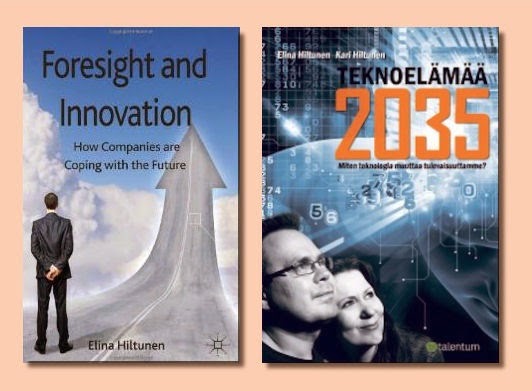
Technolife 2035: The English-language version of Teknoelämää 2035 by Finnish futurists Elina and Kari Hiltunen is now in progress and should be available soon. Elina’s previous book, Foresight and Innovation: How Companies are Coping with the Future, available in both Finnish and English, offers unique foresight tools that she has developed, such as the TrendWiki, Futures Windows, Strategic Serendipity, and the Futuropoly board game. Details 

Earth Policy Institute to Close: Leading environmental policy expert Lester R. Brown has announced his plans to retire from the think tank he founded in 2001. EPI will close by July this year, and the English-language versions of its principal publications will be housed at Rutgers University, Brown’s alma mater, in the new Lester R. Brown Reading Room. Brown’s career, spanning more than half a century, was devoted to measuring the planet’s resources and assessing its well-being, and issuing urgent warnings on such problems as climate change, overpopulation, and unsustainable consumption of resources. Details 


Frances Segraves, Former Futurist Staff Editor: We sadly report the passing of our friend and former colleague, pioneering newspaper journalist Frances Segraves, on January 14. She was 87. Frances was a staff editor for The Futurist magazine and the World Future Society Bulletin, retiring at the end of 1998. Before joining WFS to work with her longtime friends Ed and Sally Cornish, Frances was one of the first female reporters in the 1950s to cover hard news stories, working for The Frederick News, The Baltimore Sun, Bethlehem Globe-Times, and The Washington Star. She was also an activist in the anti-war and civil rights movements in the 1960s and 1970s. Details 


Send us your signals! News about your work and other tips are welcome. Contact Cynthia G. Wagner, consulting editor.  

Want more signals from AAI Foresight? Check out the blog! Log in to add comments.

Feel free to share Foresight SIGNALS with your networks and to submit any stories, tips, or “signals” of trends emerging on the horizon that we can share with other stakeholders and the foresight community. And if you’re interested in becoming a blogger for FS, please contact Cindy Wagner, our consulting editor, at CynthiaGWagner@gmail.com


Foresight SIGNALS is a publication of AAI Foresight

1619 Main Street #1172
Freeland, WA 98249

Managing Principal: Timothy C. Mack
tcmack333@gmail.com | 202-431-1652

Webmaster and IT Consultant: Tom Warner

Consulting Editor: Cynthia G. Wagner