Sunday, January 31, 2016

Foresight Signals: End of Coal? ... "Planetary Futurist" ... WFS Transition ... and more


News for the Foresight Community


> Hot Topic: The End of Coal?
> Futurists in the News: Alex Steffen
> Publications: Lifeboat Books
> In Transition: World Future Society
> In Memoriam: Maurice Strong
> Blog Report: Self-Driving Cars and Wild Nature


Hot Topic: The End of Coal?


About a dozen years ago, energy policy analyst Barbara Freese warned in her groundbreaking book, Coal: A Human History, that our use of coal would one day be condemned by future generations and that all of coal’s contributions to the industrial development we’ve come to enjoy and take for granted would be overshadowed by the predicted drastic climate changes.

While responses to Freese’s recommendation that “we move quickly and aggressively toward climate-friendly energy sources” have arguably been neither quick nor aggressive, signs of the end of our dependence on coal (and our vulnerability to its unhealthy impacts) are emerging.

Recent data from the Institute for Energy Economics and Financial Analysis show that China’s slowing economy and its move away from heavy industry toward services are dragging down demand for coal; both domestic coal production and imports have declined, and the government has announced it “will not approve any new coal mine projects for the next three years and will close down a thousand small mines,” reports Tim Buckley, IEEFA’s director of energy finance studies, Australasia. As a result, “China’s total country emissions are on track to peak potentially a decade earlier than their official target of no later than 2030.” Meanwhile, China is ramping up its investments in wind, solar, hydro, and nuclear production.

In the United States, where renewable and efficient energy investment is about half that of China ($56 billion in 2015 versus China’s $110 billion), coal is nevertheless on a downward trend, with “a 10 percent year-over-year decline in coal consumption in 2015 (and down already a staggering 29.7 percent so far in 2016) in addition to a three-year moratorium of new federal coal leases,” Buckley reports.

As one sign of the times, utilities in Oregon have agreed to phase out coal-fired plants by 2030 and to double the amount of renewable energy they generate by 2040. The measures are popular with Oregon voters—and have united some seemingly unlikely partners, Pacific Power spokesman Scott Bolton told Oregon Public Broadcasting. “Some of these folks we’ve never worked with before, so it is actually exciting to find some common interests,” he said. “You don’t see PacifiCorp and Sierra Club on the same letterhead very often.”

References: Coal: A Human History by Barbara Freese (Penguin, 2003).

Data Bite: China Continues to Drive Global Markets Lower” by Tim Buckley, Institute for Energy Economics and Financial Analysis, January 18, 2016.

Oregon Utilities Agree to Phase Out Coal-Fired Power” by Cassandra Profita, OPB/EarthFix, January 6, 2016.

Image: Steve Buissinne / Pixabay (Creative Commons license)

Signals: alternative energy, China, climate change, coal, Oregon, utilities


Futurists in the News: Alex Steffen


“Planetary futurist” Alex Steffen, author of Worldchanging and Carbon Zero, was one of a handful of non-tech innovators in the San Francisco Bay area profiled on the blog The Bold Italic. (Also profiled for the piece were a chef, a distiller, and a singer.) The article describes Steffen’s work as “environmentalism to the core but goes beyond, requiring a complete rethinking of how humanity engages with the environment” and Steffen as the kind of innovator needed “to guide us through the hazy, tough road ahead.” Read:Four Standout Bay Area Innovators Who Aren’t in Technology” by Ronny Kerr, The Bold Italic, January 15, 2016.


Publications: Lifeboat Books


The Lifeboat Foundation published three new books of fiction and nonfiction at the end of 2015. Visions of the Future, edited by J. Daniel Batt, features stories and essays on artificial intelligence, androids, life extension, and more, including contributions from Ray Kurzweil, David Brin, and Martin Rees. Prospects for Human Survival, by theoretical physicist Willard Wells, argues that technological advances may be accelerating faster than our ability to control them, suggesting that humanity should develop friendly superhuman AI as quickly as possible. The third edition of The Human Race to the Future: What Could Happen—and What to Do by Daniel Berleant also was released. Details: Lifeboat Foundation Books.


In Transition: World Future Society


In a recent announcement to members, World Future Society board chair and Interim Executive Director Julie Friedman Steele said she would be conducting a listening tour over the next few weeks to share thoughts on the future direction of the Society. With the endorsement of founder Edward Cornish and his family, WFS will hold its 2016 annual meeting July 22-24 in Washington, D.C. The conference will take the form of a summit and celebration of the Society’s 50th anniversary. WFS headquarters are now at 1875 Connecticut Ave., N.W., 10th Floor, Washington, D.C. 20009. Download FAQs and profiles of Steele and the current WFS board of directors (PDFs).


In Memoriam: Maurice Strong


Maurice F. Strong, secretary general of the UN Conference on Environment and Development, died November 30 at the age of 86. Perhaps best known as the organizer of the 1992 Rio Earth Summit, Strong was a longtime World Future Society board member and was on the Society’s Global Advisory Council through 2014. He shared his thoughts on “Reforming the United Nations” in the September-October 2001 issue of The Futurist.

“Maurice Strong was a unique voice at the World Future Society, with senior leadership experience in both the Canadian power industry and UN environmental programs, thus bridging the gap between public and private,” said former WFS President Timothy Mack, managing principal of AAI Foresight. “He also advised the UN on such delicate matters as the Korean Peninsula and China’s changing role in the world (living in Beijing for many years). He was consulted right up until his death as an expert on multilateralism and peaceful resolution of conflicts and enjoyed a high profile in the Rio and Rio+20 world environmental conferences. Strong was instrumental in promoting government funding and entry into international meetings for environmental NGOs for over 40 years.”


Blog Report: Self-Driving Cars and Wild Nature


As autonomous and semiautonomous vehicles gain powers and popularity, one potential impact has received scant attention. In his latest blog for AAI Foresight, environmental futurist David N. Bengston warns that proponents need to look beyond the first-order effects of these technologies.

“Natural systems near roads are degraded by an increased abundance of invasive species, reduced carbon sequestration, severed wildlife corridors, and spillover effects as people clear newly accessible forests and drain wetlands,” Bengston writes.

Read:Self-Driving Cars and Wild Nature” by David N. Bengston, Foresight Signals Blog (January 2016).

Signals: automobiles, highways, nature, self-driving cars, sprawl, wilderness

__________

Send us your signals! News about your work and other tips are welcome, as is feedback on Foresight Signals. Contact Cynthia G. Wagner, consulting editor. 

Want more signals from AAI Foresight? Check out the blog! Log in to add comments.

Feel free to share Foresight Signals with your networks and to submit any stories, tips, or “signals” of trends emerging on the horizon that we can share with other stakeholders and the foresight community.

__________

© 2016 AAI Foresight

Foresight Signals is a publication of AAI Foresight

1619 Main Street, #1172
Freeland, WA 98249

Managing Principal: Timothy C. Mack
tcmack333@gmail.com | 202-431-1652

Webmaster and IT Consultant: Tom Warner

Consulting Editor: Cynthia G. Wagner

Designer: Lisa Mathias

Saturday, January 23, 2016

Self-Driving Cars and Wild Nature

By David N. Bengston

People have been thinking and dreaming about self-driving cars for a long time. Paleofuture.com’s article about the “Driverless Car of the Future” (Novak 2010) features a 1957 magazine ad depicting a family playing Scrabble in a bubble-topped car as it cruises down a six-lane freeway, the steering wheel pointedly unattended. The ad copy reads in part, “One day your car may speed along an electric super-highway, its speed and steering automatically controlled by electronic devices embedded in the road. Highways will be made safe—by electricity! No traffic jam … no collisions … no driver fatigue.”

Self-driving cars are, of course, no longer a futuristic idea. Virtually every car company is working on them, along with tech companies such as Google (now Alphabet) and Apple. More and more self-driving features are available in cars today. They’re coming, and sooner than many of us think. A recent Business Intelligence report (Greenough 2015) forecasts 10 million autonomous vehicles on the roads by 2020, some semiautonomous and some fully autonomous.

The first-order impacts of autonomous vehicles will be to transform transportation and mobility. Other travel-related industries will be among the first to feel the effects. For example, self-driving cars could reduce the need for short-haul domestic flights, hotels, and car rentals as travelers sleep en route and have their own cars at the destination (dezeen 2015).

But self-driving vehicles will also have many unintended higher-order impacts. In his book Future Ride, technology writer Peter Wayner identifies scores of ways in which every aspect of society will be affected (Wayner 2015). The lengthy subtitle of Wayner’s book points to a few of these impacts: “99 Ways the Self-Driving, Autonomous Car Will Change Everything from Buying Groceries to Teen Romance to Turning Ten to Having a Heart Attack ... to Simply Getting from Here to There.”

A likely higher-order consequence of self-driving cars that has received little attention is their impacts on natural areas. The effects could be profound. One possibility is that the comforts and efficiencies of self-driving cars may result in much longer commutes and more sprawling development. If you can eat your breakfast, watch the news, surf the Web, catch up on your reading, do some work, or take a nap on your commute, you may live farther out in undeveloped areas. Self-driving cars may reduce the need for roads in cities, but they could induce more road building and low-density development in remote areas.

Roads create serious environmental impacts (Haddad 2015). Natural systems near roads are degraded by an increased abundance of invasive species, reduced carbon sequestration, severed wildlife corridors, and spillover effects as people clear newly accessible forests and drain wetlands. The net effect is a loss of wild nature much greater than just the area of the road’s path, and a resulting loss of life-supporting ecosystem services.

The consequences of road-building and cars have been a concern among conservationists since the rapid spread of automobiles in the 1920s. Historian Paul Sutter (2002) details how this concern motivated leaders in conservation and wilderness preservation. The future of conservation could be threatened by a new era of fragmented landscapes and sprawl. Of the 50 largest U.S. cities, only about 6 percent even mention self-driving cars in their long-range transportation plans (Cutler 2015).

Foresight is needed to identify and prepare for the possible effects of self-driving cars and other major disruptive technologies. Foresight tools such as the futures wheel can help planners and policy makers anticipate unforeseen consequences of change and be more proactive, designing policies to discourage negative effects and encourage positives (Bengston 2015). Most analyses of the implications of change don’t go beyond the obvious direct consequences. But the higher order consequences are less obvious, often contain surprises, and may be the most significant.

The smart group process, graphic structure, and nonlinear thinking of the futures wheel make it a powerful tool for identifying and evaluating possible implications of change. Land-use and transportation policies informed by foresight are needed to effectively manage urban growth and protect open space in the decades ahead.

References

Bengston, D.N. “The futures wheel: A method for exploring the implications of social–ecological change. Society & Natural Resources: An International Journal. Published online August 25, 2015. DOI: 10.1080/08941920.2015.1054980

Cutler, Kim-Mai. How many American cities are preparing for the arrival of self-driving cars? Not many.” TechCrunch.com November 9, 2015. http://techcrunch.com/2015/11/09/cities-self-driving-cars/?ncid=rss&sr_share=twitter#.8p4mjvz:XbDp

dezeen Magazine. “Driverless cars could spell the end for domestic flights, says Audi strategist.” November 25, 2015. http://www.dezeen.com/2015/11/25/self-driving-driverless-cars-disrupt-airline-hotel-industries-sleeping-interview-audi-senior-strategist-sven-schuwirth/

Greenough, John. “The self-driving car report: Forecasts, tech timelines, and the benefits and barriers that will impact adoption.” BI Intelligence. July 1, 2015. http://www.businessinsider.com/report-10-million-self-driving-cars-will-be-on-the-road-by-2020-2015-05

Haddad, Nick M. “Corridors for people, corridors for nature: How can the environmental impacts of roads be reduced?” Science 360(6265): 1166-1167. December 4, 2015. DOI: 10.1126/science.aad5072.

Novak, Matt.  “Driverless Car of the Future.” Paleofuture.com. December 9, 2010.  http://paleofuture.com/blog/2010/12/9/driverless-car-of-the-future-1957.html

Sutter, P.S. Driven Wild: How the Fight Against Automobiles Launched the Modern Wilderness Movement. University of Washington Press, 2002. p.343. http://www.washington.edu/uwpress/search/books/SUTDRI.html

Wayner, Peter. Future Ride v2: 99 Ways the Self-Driving, Autonomous Car Will Change Everything from Buying Groceries to Teen Romance to Turning Ten to Having a Heart Attack ... to Simply Getting from Here to There. Self-published and copyrighted. Sold by Amazon Digital Services Inc., 2015. p.227. http://futureridebook.com/

About the Author

David N. Bengston, environmental futurist for the U.S. Forest Service, Northern Research Station, Strategic Foresight and Rapid Response Group, is co-author (with Robert L. Olson) of the AAI Foresight Report “A World on Fire.” E-mail dbengston@fs.fed.us. Image: Automobile Italia/Flickr.

Saturday, January 9, 2016

Signals: Predictionzzz ... Luddite Shaming ... Technolife 2035 ... and more

Vol. 2, No. 3 | January 13, 2016 | AAI Foresight

News for the Foresight Community


> Hot Topic: Predictionzzz
> Unnecessary Roughness: Luddite Shaming
> Publication: Technolife 2035
> Special Issue: Journal of Futures Studies and Science Fiction
> On the Move: Brian David Johnson
> Foresight Report: Digital Citizenship
> ICYMI: End of Year Report
> Feedback: On “How Technology Professionals Will Work”


Hot Topic: Predictionzzz


The beginning of a New Year was greeted with the usual popular media attention to “the future,” which means collections of ongoing and imminent trends disguised as click-attracting predictions. For futurists and other foresight professionals, it is an opportunity to capture the imaginations of those otherwise preoccupied by the present, even as we remind ourselves of our true purpose.

The usual futuristic subjects—artificial intelligence, virtual reality, and robotics—appeared in some lists, but a few twists on these topics caught our eye: In Ireland, a Future of Law and Legal Tech Conference, warned that lawyers could go extinct if they don’t reduce their fees and streamline their practices. “Eight out of ten U.S. law firms believe that robots will take over most low level and data- driven procedures within 10 years,” reports the Independent.

Writing on LinkedIn Pulse, Singapore futurist Harish Shah had a slightly different take on the annual predictions exercise: He offered a list of technologies that will be obsolete by 2030, including physical monitors, which will be replaced with holographic displays, and nearly all forms of computer we now rely on—PCs, laptops, tablets, and smartphones—which will be replaced by wearables.

Comment: I find the latter forecast a bit disconcerting, as I attempt to execute this newsletter on a five-year-old (no longer manufacturer-supported) laptop with a dead battery. Though I’ve achieved the paperless future, I’m not yet ready for the holographic one. —CGW

References: Lawyers Told to Cut Fees or Face Future Led by Robots” by Dearbhail McDonald, Independent (December 17, 2015).

Obsolete By 2030: A List of Tech Items We Cannot Imagine Life Without Today” by Harish Shah, LinkedIn Pulse (January 6, 2016).


Unnecessary Roughness: Luddite Shaming


The Information Technology and Innovation Foundation’s second annual Luddite of the Year Award is still taking nominations. The “honor,” ITIF says, “recognizes the year’s most egregious example of a government, organization, or individual stymieing the progress of technological innovation.”

Topping the not-in-any-particular-order list of nominees for 2015 are the duo “alarmists” Elon Musk and Stephen Hawking, nominated for their endorsement of last year’s open letter to their scientific peers warning of the danger of creating an artificial intelligence. (See the story in the April 2015 Foresight Signals.)

Comment: While we certainly admire ITIF’s work to encourage innovation, shaming respected scientific leaders for encouraging others to consider the potential negative consequences of their work strikes us as counter to the mission of foresight generally and technology assessment specifically. The real Luddite awards should be reserved for those who attempt to ban the research they fear,* which Musk and Hawking did not do; they asked for broader research, not no research. —CGW


Signals: artificial intelligence, innovation, Luddites, technology


Publication: Technolife 2035


The English-language version of Elina and Kari Hiltunen’s Technolife 2035: How Will Technology Change Our Future? has now been published by Cambridge Scholars Publishing.

In addition to providing a comprehensive overview of technology forecasting methodologies, the authors offer an insightful vision of where technologies may lead us into the future. The text concludes with three extended scenarios based on a reimagining of the Romeo and Juliet story, first presented in The Futurist magazine (July-August 2014).

In their preface, the authors invite readers to put the book away and leave it in a drawer for another 20 years, the open it again for a “burst of laughter” at how “silly were they back then.” For we no doubt will all predict a few silly things and miss quite obvious ones, the authors admit. But prediction, they point out, is not the point, but rather raising “discussion about what technology can bring with it—both the good and bad.”


Signals: foresight, scenarios, society, technology


Special Issue: Journal of Futures Studies and Science Fiction


The December 2015 issue of the Journal of Futures Studies, co-edited by Thomas Lombardo and Jose Ramos, focused on the relationship between science fiction and foresight. In the lead article “Science Fiction: The Evolutionary Mythology of the Future,” Lombardo writes that those science fiction works that deal with the future may be viewed as narratives of tomorrow's possibilities.

“A good story about a possible future, with its drama, action, and sensory detail, is psychologically more compelling and realistic than an abstract theory, static image, depersonalized futurist scenario, or statistical prediction,” Lombardo writes. “Science fiction personally draws us into a rich vicarious experience of the future through its vivid and memorable characters. We live the story through the characters. All told, through science fiction narrative, we live and feel the future at a deep and intimate level.”

Reference: Science Fiction: The Evolutionary Mythology of the Future(PDF) by Tom Lombardo, Journal of Futures Studies (December 2015).

Signals: futurism, science fiction


On the Move: Brian David Johnson


Longtime Intel futurist Brian David Johnson has joined the faculty of Arizona State University as a “professor of practice” in the School for the Future of Innovation in Society and futurist in residence for the spring 2016 term. At ASU Johnson will lead two major projects: The Future of the American Dream and the 21st Century Robot.

“I’m so excited about the future and what we’ll be able to accomplish,” Johnson said. “ASU is one of the world’s most innovative and forward-looking institutions. It’s the perfect place to collaborate with a broad, diverse set of people and to explore the future in exciting, intellectually rigorous and surprising ways.”


Signals: education, futurists, robotics


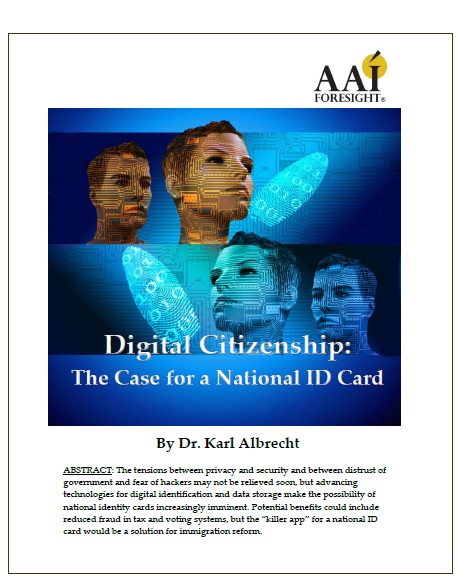
Foresight Report: Digital Citizenship


In AAI Foresight's latest Foresight Report, “Digital Citizenship,” futurist consultant Karl Albrecht describes many advantages of a national digital ID system, including what might be the “killer app”——immigration reform. The digital citizenship program he describes would tackle at least one fundamental issue: determining who is a citizen and who is a “guest.” What to do with guests determined to be where they shouldn't be has yet to be resolved.

Albrecht observes that the technical obstacles to creating a connected but secure and anonymous database system to establish national identity are not as daunting as are the political and social obstacles. Fears of government overreach match fears of hacking and terrorism, and as long as the supporters match the opponents of a national ID system, a satisfactory system is unlikely to come about soon.

Reference: “Digital Citizenship: The Case for a National ID Card” by Karl Albrecht (Foresight Report, Winter 2016). Contact Albrecht at www.karlalbrecht.com. “Digital Citizens” is AAI Foresight’s sixth Foresight Report and is available as a free PDF download. Access the series at www.aaiforesight.com/foresight-reports.

Signals: citizenship, digital society, information technology, privacy, security


ICYMI: Mack Report


In case you missed it: In his end-of-year report, Tim Mack reviews the activities and accomplishments of the first full year of operations for AAI Foresight Inc. In addition to a number of internal and external publishing projects, Mack participated in a new science-focused series, SciTech Voyager TV series for Turkish Radio Television. See AAI Foresight Year-End Report, Foresight Signals (December 2015).


Feedback: Technology Work and Technological Displacement


In response to Timothy Mack’s Foresight Report “How Technology Professionals Will Work” (Foresight Report, Fall 2015), Dennis Bushnell, chief scientist at NASA Langley Research Center, writes:

What is new this time with machines replacing humans is that … we are now producing a second intelligent species. The unanticipated huge and evolving success of the combination of deep learning, big data, and fast machines is producing greatly improved machine intelligence via soft computing long before brain emulation is slated to do so. Therefore, the machines taking the jobs, including the creative jobs, is now being accelerated.

Much of [Mack’s] piece is nearer term, as humans try to fight desperately to hang onto traditional thinking and functions. It is all going to have to be wholly reinvented, [as I discussed in] “Creating Problems and Enabling Solutions (Foresight Report, Summer 2015). “We reinvented humans … twice before: the agricultural age and the industrial age. In each there was a major change in what humans did and [in] their social fabric. This new “Machine Revolution” [will] have essentially all of the human capabilities for economic activities, including creativity, only far greater and far more than humans. If anything this is even more of a sea change to the human existence theorem than the Agricultural and Industrial [revolutions].

Humans have simply been too successful and have invented themselves out of their jobs. Humans 3.0 is now “our” horizon. Much of what you cover in this present piece is rapidly being transcended.

Contact: Dennis M. Bushnell, dennis.m.bushnell@nasa.gov.

__________

Send us your signals! News about your work and other tips are welcome, as is feedback on Foresight Signals. Contact Cynthia G. Wagner, consulting editor. mailto:CynthiaGWagner@gmail.com

Want more signals from AAI Foresight? Check out the blog! Log in to add comments.

Feel free to share Foresight Signals with your networks and to submit any stories, tips, or “signals” of trends emerging on the horizon that we can share with other stakeholders and the foresight community.

__________

© 2016 AAI Foresight

Foresight Signals is a publication of AAI Foresight

1619 Main Street, #1172
Freeland, WA 98249

Managing Principal: Timothy C. Mack
tcmack333@gmail.com | 202-431-1652

Webmaster and IT Consultant: Tom Warner

Consulting Editor: Cynthia G. Wagner

Designer: Lisa Mathias


Sunday, December 27, 2015

AAI Foresight Year-End Report

Special Edition: December 2015

AAI Foresight Year-End Report

By Timothy C. Mack, Managing Principal

At the end of 2015, it is encouraging to look back on AAI Foresight’s first full year in business. We are especially proud of our publishing arm, which has grown from an excellent newsletter (according to the reader feedback) and a founder’s blog that has gradually picked up fellow bloggers, to a satisfying report series (all edited by the very able Cynthia Wagner) with a widely ranging focus. Starting with our launch report on the global wildfire crisis, these subjects have included Foresight in Finland, new technologies in the aerospace sector, and the future of the retail industry. And we are always looking for new opportunities to showcase innovative foresight, so please continue to send things our way.


We have also been quite productive outside of in-house publishing. AAI finished up the briefing white paper for IEEE’s incoming leadership on the future of the tech workplace, and an AAI Report version expanding upon that work came out last month. As well, an article in Career Planning and Adult Development Journal on “Training Challenges Facing Education and Training and Career Development in the Future” was part of a special issue edited by Dr. Helen Harkness. (Read summary here.)

Emerald Group Publishing released Leadership 2050: Critical Challenges, Key Contexts, and Emerging Trends, edited by Matthew Sowicik, with the lead-off article on “Leadership in the Future” written at AAI. We also completed a three-episode portion of the SciTech Voyager TV series for Turkish Radio Television at the beginning of December, which involved segments on fusion power, wireless electricity and bioplastics. It will be released in Istanbul in 2016, but should also be available on the Web. AAI is now involved with an event series hosted by the MIT Enterprise Forum Northwest in Seattle. This project came out of that group’s Science Fiction and the Future program last year, which AAI Associate Brenda Cooper had a role in developing. AAI’s MITEF-NW projects to date have included events on geoengineering and AI/robotics.


On the revenue side,  a couple of potentially very interesting projects have sadly gone sideways, including the global financial services trends contract, which was put on hold when the highly supportive CEO unexpectedly left to take another position elsewhere. We completed a study on the future of the Indian Ocean region last year, and a number of our potential projects still hanging fire have come out of Europe, covering a range of topics: hotel industry marketing, environmental entrepreneurism, and UN Millennium Development Goals management, for instance. One project still in development involves MyReputationLab.com. This came through AAI Associate Mylena Pierremont at July’s WorldFuture 2015 conference in San Francisco. That new endeavor will involve innovative approaches to personal and organizational reputation management worldwide.

The most productive revenue sector for 2015 (and already looking auspicious for 2016) has been electric power management and related technologies (also known in some arenas as electro-technical issues). That area has been paying a number of AAI’s bills over this year and looks highly likely to expand in the coming year, both within North America and beyond, following the year-on-year growth trajectory since 2014.


As some of you might be aware, the AAI Foresight home office moved during 2015 to the highest point on Whidbey Island in Puget Sound, which is the longest island on the Pacific Coast of the contiguous United States. While not suggesting that there is any concern about our proximity to the Cascadia Fault (which is 50 miles offshore) the new building is definitely at the high end of present earthquake mitigation building technology. Coincidently, this provides an entrĂ©e to the mention of a new book due out next year, titled Reinventing Green Building by Jerry Yudelson (formerly CEO of the Green Building Initiative), from New Society Publishers in British Columbia. AAI’s contribution to that book is an epilogue on the future of green building technologies.

In closing, I would like to give thanks to AAI’s (now 16 in number) Associates and our in-house staff—Tom Warner and Lisa Mathias—who have contributed much to our prosperous year, our publications, and the redesign of the AAI Foresight website. For those of you familiar with World Future Review, long managed by Dr. Lane Jennings, you will be pleased to know that it is being relaunched with SAGE Publications under the able guidance of James Dator, with Lane and myself serving on its new Board of Editors.

Take care,
Tim Mack
202-431-1652, tcmack333@gmail.com