Showing posts with label recycling. Show all posts

Sunday, March 29, 2015

Signals: The Consequences of Adaptation... and more

Vol. 1, No. 11 | April 1, 2015 | AAI Foresight

Inside Foresight Signals

> Adaptation and Its Consequences
> From Natural Gas to Biogas
> Contingency Exercises Urged for Power Companies
> Nanotech and Cancer: Report from Timothy C. Mack
> News for the Foresight Community


Adaptation and Its Consequences


The efforts that societies put into adapting to climate change may in themselves put even more pressure on the environment, warns a study led by Carlo Fezzi of the University of East Anglia’s School of Environmental Sciences.

The researchers used computer models based on data since the 1970s to predict how climate change would alter agricultural practices in Britain, and how those changes would in turn affect river water quality. They found that, though moderate increases in temperature could boost agricultural productivity and allow for more livestock in the eastern uplands and midlands, the increased intensity in farming and herding would generate more runoff of nitrates and phosphates in rivers and streams.

Similarly, other industries that are forced to adapt to climate change, such as energy, forestry, fisheries, and even health services, will also have to beware of the “knock on” effects of adaptation, the researchers warn.

“We need to take into account not only the direct impact of climate change, but also how people will respond to such change—the impact of adaptation,” Fezzi said in a press statement. “Climate change is a long-term process and science allows us to anticipate its impact on both the environment and society. This should encourage the development of forward-looking policies.”

Source: University of East Anglia. Reference: Carlo Fezzi et al., “The environmental impact of climate change adaptation on land use and water quality,” Nature Climate Change (March 2015), pp. 255-260. DOI: 10.1038/nclimate2525. Image: Graeme Law, via Flickr (Creative Commons license).

Signals: adaptation, agriculture, climate change


From Natural Gas to Biogas


Pilgrim’s, a chicken-processing plant in Mexico, has been able to purify fats, waste, and other residues to produce a biogas capable of replacing natural gas as its energy source. And Xaquixe, a pottery and glass-art maker, has generated biogas from pig and cow manure, providing energy for its operations.

The two companies were participants in pilot projects to demonstrate techniques developed by Mexico’s Center for Research and Technological Development in Electrochemistry (CIDETEQ), in partnership with specialists from the University of Brandenburg in Germany.

The biogas generated is a mixture of methane, carbon dioxide, nitrogen, and water vapor, as well as potentially harmful compounds like hydrogen sulfide. As such, the biogas must be properly assessed and treated before it can be used.

Distillers of mescal, a liquor similar to tequila, may also benefit from the process, using biogas to replace firewood.

Details (in Spanish): Investigación y Desarrollo.

Signals: bioprocessing, energy, recycling


Contingency Exercises Urged for Power Companies


A hacking attack on a power distribution company isn’t just the IT department’s problem, and in a crisis, everyone needs to be prepared, warn Maria Line and Nils Brede Moe of the research consortium SINTEF.

In Norway, the power industry has been too “laid back,” despite experiencing the country’s first attack in the summer of 2014. Line and Moe observed contingency exercises with three power-distribution companies and found them largely unprepared for a variety of scenarios.

“One of the companies we talked to had an agreement simply to call and rely on its supplier if a crisis occurred,” Line said in a press statement. “And even then, the supplier didn't take part in the exercise.”

Based on their observations, Line and Moe recommend that as many employees as possible participate in contingency exercises, especially including upper management who would be the key decision makers if the call must be made to shut down a plant.

Frequent scenario exercises are also important, but the same exercises should not be repeated; rather, new contingencies must continually be imagined and prepared for, the researchers conclude.

Source: SINTEF via AlphaGalileo

Signals: emergency management, hackers, IT, power distribution, scenario planning, utilities


Nanotech and Cancer: Report from Timothy C. Mack


One of the most encouraging trends in medicine in recent years is the growth of systemic approaches to problem solving, such as in improving chemotherapy delivery in cancer treatment.

Historically, the challenge has been to target drugs accurately at cancer cells; the powerful drugs may often cause damage to surrounding healthy tissue. The body may also treat these medical interventions as intruders, attacking and disabling them through human immune mechanisms.

Recently, researchers have used nanotech to create protective vehicles and delivery mechanisms that now appear to overcome these obstacles. After delivering drugs to their targets, these vehicles dissolve in the high-acid cores of cancer tumors. As is often the case in new and converging technological developments, developments such as this are likely to further accelerate advances in related technology solutions. Read more.

Timothy C. Mack is managing principal of AAI Foresight Inc. This report is excerpted from the Foresight Signals blog. Image: Rhoda Baer, National Cancer Institute.

Signals: cancer, medicine, nanotechnology


News for the Foresight Community


• Honors: Young Futurists of 2015. Influential media company The Root has named 25 young African Americans to its 2015 Young Futurists list honoring social activism and academic and entrepreneurial achievements of students ages 16 to 22. Among this year’s honorees is Allyson Carpenter, 18, of Howard University, who became the youngest elected official in Washington, D.C. The Root covers news, opinion, and culture from an African American perspective.


 • Book: The Naked Future. Technology journalist Patrick Tucker’s 2014 book The Naked Future: What Happens in a World That Anticipates Your Every Move? is now out in paperback! (Current, 2015, $16.) The cloth edition released last year was named Amazon’s book of the month for March: “Tucker has penned a big data book that can be understood by both technophiles and luddites alike,” wrote Amazon reviewer Kevin Nguyen. And Ray Kurzweil, author of How to Create a Mind, called it “Thought-provoking, eye-opening, and highly entertaining.” Patrick Tucker is the technology reporter/editor with Defense One; follow him on Twitter, @DefTechPat.


• Petition: Open Letter on AI. The Boston-based Future of Life Institute has posted an open letter on research priorities for artificial intelligence, aiming to ensure “that increasingly capable AI systems are robust and beneficial.” Among the dozens of signatories to the letter are theoretical physicist Stephen Hawking, SpaceX and Tesla Motors founder Elon Musk, Google research director Peter Norvig, philosophy professor Nick Bostrom, io9 contributing editor George Dvorsky, and science-fiction author David Brin. Details: Future of Life. Download PDF: Research Priorities for Robust and Beneficial Artificial Intelligence.

• Signal of the Month: DEAL. The jobs outlook in the United States faces a new DEAL: the combined forces of Demographics, Education, Automation, and Longevity (The Gordon Report, March 2015). Baby boomers will be living longer, and they’ll need to be replaced in the workforce. If they wish to continue working, they’ll need appropriate training, as automation takes over many low-skill and middle-skill jobs. Signal courtesy of Edward E. Gordon, president of Imperial Consulting Corporation.


Send us your signals! News about your work and other tips are welcome. Contact Cynthia G. Wagner, consulting editor.  

Want more signals from AAI Foresight? Check out the blog! Log in to add comments.

Feel free to share Foresight Signals with your networks and to submit any stories, tips, or “signals” of trends emerging on the horizon that we can share with other stakeholders and the foresight community. And if you’re interested in becoming a blogger for FS, please contact Cindy Wagner, our consulting editor, at CynthiaGWagner@gmail.com


© 2015 AAI Foresight

Foresight Signals is a publication of AAI Foresight

1619 Main Street #1172
Freeland, WA 98249

Managing Principal: Timothy C. Mack
tcmack333@gmail.com | 202-431-1652

Webmaster and IT Consultant: Tom Warner

Consulting Editor: Cynthia G. Wagner

Designer: Lisa Mathias


Thursday, January 29, 2015

Signals: Minor Infections, Major Problems... Waterless Recycling... Autonomous Autos... and more


Vol. 1, No. 7 | February 2, 2015 | AAI Foresight 

Inside Foresight SIGNALS

> Minor or Hidden Infections May Accelerate Mortality
> Dry Innovation for Plastics Recycling
> Liability and the Self-Driving Car: Report from Timothy Mack
> Scholarly Researchers Embrace Skepticism
> Futurists and Foresight in the News

Minor or Hidden Infections May Accelerate Mortality


If you escaped that horrific flu or other infection that’s been going around in your neighborhood, school, or workplace, you may count yourself lucky. Maybe you only got a mild infection, or felt well and kept on working just as effectively as ever. The bad news is that such hidden or mild, untreated infections could be shortening your life.

In studies of migratory birds with mild malaria infections, researchers at Sweden’s Lund University discovered that the cumulative effects of chronic infections shortened the birds’ telomeres—the caps on chromosomes that protect DNA—accelerating the aging process.

“The small, non-measureable effects of the chronic disease appear to underlie the accelerated shortening of the telomeres. When the telomeres get too short, this has a fatal effect and causes premature death,” said Lund researcher Dennis Hasselquist of the Department of Biology, a member of the research team. “If this is a general mechanism for any type of mild, chronic infection, which is quite possible, it will mean our study is of major interest to understand the impact that mild illnesses can have on other organisms, including humans.”

Reference: M. Asghar, D. Hasselquist, B. Hansson, P. Zehtindjiev, H. Westerdahl, S. Bensch, “Hidden costs of infection: Chronic malaria accelerates telomere degradation and senescence in wild birds,” Science (January 23, 2015), Vol. 347, No. 6220, pp. 436-4381. DOI: 10.1126/science.1261121 

Signals: aging, health, longevity, telomeres


Dry Innovation for Plastics Recycling


Water-intensive processes for recycling plastic waste could one day be replaced with new techniques that don’t require liquids. A dry recycling process developed by Ak Inovex of Mexico also promises to reduce energy consumption, use less space, and cut costs.

Using customizable machinery, the process can work with any type of plastic material, such as Styrofoam and polystyrene, to produce small plastic beads or pellets. Rather than dehydrating the original materials at high heat and then cooling them with water, Ak Inovex uses a patent-pending process of cooling through contact with special walls.

The company now plans to add biodetergents to the cleaning process for the recycled plastic products, thus keeping water use and costs at the lowest possible levels. Ak Inovex was a participant in Cleantech Challenge Mexico, a contest to promote the development of green companies. (See also “Power Pedaling with Bamboo Bike,” Foresight SIGNALS, Vol. 1, no. 6.)

Source: Investigación y Desarrollo [in Spanish].

Signals: green technology, innovation, Mexico, plastics, recycling, water


Liability and the Self-Driving Car: Report from Timothy Mack


The auto industry is clearly convinced that the question of autonomous vehicles is “not if, but when.” But the potential impacts on the industry, such as liability issues, are less clear.

Motor Trend analyst Frank Markus notes a number of relatively clear benefits of a working national autonomous-vehicle system, such as reduced accidents, increased mobility for nondrivers, reduced fuel consumption, and more intelligent driving patterns. 

But one of the most interesting questions regards autonomous and driver-controlled vehicles sharing the same roadways: If there are far fewer accidents, there will still be accidents, but probably fewer insurers to cover them. Who is responsible when accidents happen? Who pays? Rather than owners of autonomous vehicles taking out insurance (and paying premiums), would it fall on manufacturers to indemnify their products?

One possibility is public/private special compensation funds to underwrite unintended consequences. Owners of older, non-autonomous cars might be required to financially subsidize the rollout of presumably safer autonomous vehicles and road systems. Of course, manufacturers’ liability remains a toss-up in any court of law.

Timothy Mack is the managing principal of AAI Foresight Inc. This report was adapted from the Foresight SIGNALS Blog. Image credit: Sam Churchill, via Flickr (Creative Commons license).

Signals: AI, autonomous vehicles, insurance, law, transportation


Scholarly Researchers Embrace Skepticism


A journal devoted to exploring the philosophical concept of skepticism has now been included in Scopus, a database of peer-reviewed literature that covers nearly 22,000 titles by 5,000 publishers worldwide. Scopus offers researchers wide access to tools to facilitate tracking, analysis, and visualization of research.

Brill’s International Journal for the Study of Skepticism, edited by Diego E. Machuca (CONICET, Argentina) and Duncan H. Pritchard (University of Edinburgh), publishes articles and organizes symposiums on all aspects of skeptical thought and current problems, including debates on epistemology, metaethics, and the philosophy of religion, among many other topics.

“The journal is fully committed to the highest standards of clarity and rigor, and serves as a forum for debate and exchange of ideas among leading international philosophers and scholars,” according to its mission statement.

Brill is an international academic publisher based in Lieden, the Netherlands, covering Middle East and Islamic Studies, Asian Studies, Classical Studies, History, Biblical and Religious Studies, Language and Linguistics, Biology, International Law, and more.

Details: Brill press release. Follow @Scopus on Twitter.

Signals: academic publishing, philosophy, research, skepticism


Futurists and Foresight in the News


Global Strategic Foresight Community: The World Economic Forum has established a new future-oriented interest group comprising leaders and stakeholders in government, industry, and the foresight profession. Among the participants are The Art of the Long View author Peter Schwartz of Salesforce.com, The Millennium Project founder Jerome C. Glenn, NATO strategic analyst Stephanie Babst, and Julius Gatune of the African Centre for Economic Transformation. The GSFC will “provide a peer network to compare and contrast insights as well as to positively shape future-related industry, regional and global agendas.” Details 


Survey on New Approaches in Foresight: Futurists around the world often develop new methodologies, which may affect outcomes in their foresight work. To better understand these new approaches and their impacts on science, technology, and innovation policy around the world, particularly Southeast Asia, The Future Impacts Consulting firm invites Foresight SIGNALS readers to participate in a brief survey (deadline February 6). Details: Contact Cornelia Daheim, daheim@future-impacts.de 

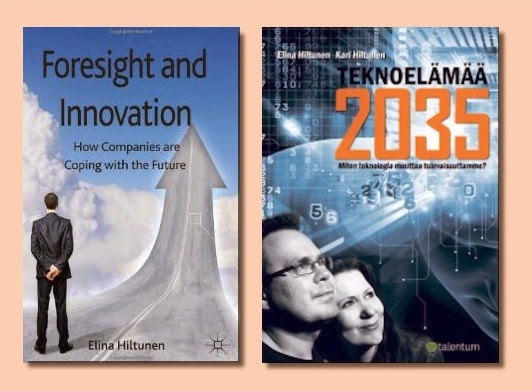
Technolife 2035: The English-language version of Teknoelämää 2035 by Finnish futurists Elina and Kari Hiltunen is now in progress and should be available soon. Elina’s previous book, Foresight and Innovation: How Companies are Coping with the Future, available in both Finnish and English, offers unique foresight tools that she has developed, such as the TrendWiki, Futures Windows, Strategic Serendipity, and the Futuropoly board game. Details 

Earth Policy Institute to Close: Leading environmental policy expert Lester R. Brown has announced his plans to retire from the think tank he founded in 2001. EPI will close by July this year, and the English-language versions of its principal publications will be housed at Rutgers University, Brown’s alma mater, in the new Lester R. Brown Reading Room. Brown’s career, spanning more than half a century, was devoted to measuring the planet’s resources and assessing its well-being, and issuing urgent warnings on such problems as climate change, overpopulation, and unsustainable consumption of resources. Details 


Frances Segraves, Former Futurist Staff Editor: We sadly report the passing of our friend and former colleague, pioneering newspaper journalist Frances Segraves, on January 14. She was 87. Frances was a staff editor for The Futurist magazine and the World Future Society Bulletin, retiring at the end of 1998. Before joining WFS to work with her longtime friends Ed and Sally Cornish, Frances was one of the first female reporters in the 1950s to cover hard news stories, working for The Frederick News, The Baltimore Sun, Bethlehem Globe-Times, and The Washington Star. She was also an activist in the anti-war and civil rights movements in the 1960s and 1970s. Details 


Send us your signals! News about your work and other tips are welcome. Contact Cynthia G. Wagner, consulting editor.  

Want more signals from AAI Foresight? Check out the blog! Log in to add comments.

Feel free to share Foresight SIGNALS with your networks and to submit any stories, tips, or “signals” of trends emerging on the horizon that we can share with other stakeholders and the foresight community. And if you’re interested in becoming a blogger for FS, please contact Cindy Wagner, our consulting editor, at CynthiaGWagner@gmail.com


Foresight SIGNALS is a publication of AAI Foresight

1619 Main Street #1172
Freeland, WA 98249

Managing Principal: Timothy C. Mack
tcmack333@gmail.com | 202-431-1652

Webmaster and IT Consultant: Tom Warner

Consulting Editor: Cynthia G. Wagner