Thursday, January 29, 2015

Signals: Minor Infections, Major Problems... Waterless Recycling... Autonomous Autos... and more


Vol. 1, No. 7 | February 2, 2015 | AAI Foresight 

Inside Foresight SIGNALS

> Minor or Hidden Infections May Accelerate Mortality
> Dry Innovation for Plastics Recycling
> Liability and the Self-Driving Car: Report from Timothy Mack
> Scholarly Researchers Embrace Skepticism
> Futurists and Foresight in the News

Minor or Hidden Infections May Accelerate Mortality


If you escaped that horrific flu or other infection that’s been going around in your neighborhood, school, or workplace, you may count yourself lucky. Maybe you only got a mild infection, or felt well and kept on working just as effectively as ever. The bad news is that such hidden or mild, untreated infections could be shortening your life.

In studies of migratory birds with mild malaria infections, researchers at Sweden’s Lund University discovered that the cumulative effects of chronic infections shortened the birds’ telomeres—the caps on chromosomes that protect DNA—accelerating the aging process.

“The small, non-measureable effects of the chronic disease appear to underlie the accelerated shortening of the telomeres. When the telomeres get too short, this has a fatal effect and causes premature death,” said Lund researcher Dennis Hasselquist of the Department of Biology, a member of the research team. “If this is a general mechanism for any type of mild, chronic infection, which is quite possible, it will mean our study is of major interest to understand the impact that mild illnesses can have on other organisms, including humans.”

Reference: M. Asghar, D. Hasselquist, B. Hansson, P. Zehtindjiev, H. Westerdahl, S. Bensch, “Hidden costs of infection: Chronic malaria accelerates telomere degradation and senescence in wild birds,” Science (January 23, 2015), Vol. 347, No. 6220, pp. 436-4381. DOI: 10.1126/science.1261121 

Signals: aging, health, longevity, telomeres


Dry Innovation for Plastics Recycling


Water-intensive processes for recycling plastic waste could one day be replaced with new techniques that don’t require liquids. A dry recycling process developed by Ak Inovex of Mexico also promises to reduce energy consumption, use less space, and cut costs.

Using customizable machinery, the process can work with any type of plastic material, such as Styrofoam and polystyrene, to produce small plastic beads or pellets. Rather than dehydrating the original materials at high heat and then cooling them with water, Ak Inovex uses a patent-pending process of cooling through contact with special walls.

The company now plans to add biodetergents to the cleaning process for the recycled plastic products, thus keeping water use and costs at the lowest possible levels. Ak Inovex was a participant in Cleantech Challenge Mexico, a contest to promote the development of green companies. (See also “Power Pedaling with Bamboo Bike,” Foresight SIGNALS, Vol. 1, no. 6.)

Source: Investigación y Desarrollo [in Spanish].

Signals: green technology, innovation, Mexico, plastics, recycling, water


Liability and the Self-Driving Car: Report from Timothy Mack


The auto industry is clearly convinced that the question of autonomous vehicles is “not if, but when.” But the potential impacts on the industry, such as liability issues, are less clear.

Motor Trend analyst Frank Markus notes a number of relatively clear benefits of a working national autonomous-vehicle system, such as reduced accidents, increased mobility for nondrivers, reduced fuel consumption, and more intelligent driving patterns. 

But one of the most interesting questions regards autonomous and driver-controlled vehicles sharing the same roadways: If there are far fewer accidents, there will still be accidents, but probably fewer insurers to cover them. Who is responsible when accidents happen? Who pays? Rather than owners of autonomous vehicles taking out insurance (and paying premiums), would it fall on manufacturers to indemnify their products?

One possibility is public/private special compensation funds to underwrite unintended consequences. Owners of older, non-autonomous cars might be required to financially subsidize the rollout of presumably safer autonomous vehicles and road systems. Of course, manufacturers’ liability remains a toss-up in any court of law.

Timothy Mack is the managing principal of AAI Foresight Inc. This report was adapted from the Foresight SIGNALS Blog. Image credit: Sam Churchill, via Flickr (Creative Commons license).

Signals: AI, autonomous vehicles, insurance, law, transportation


Scholarly Researchers Embrace Skepticism


A journal devoted to exploring the philosophical concept of skepticism has now been included in Scopus, a database of peer-reviewed literature that covers nearly 22,000 titles by 5,000 publishers worldwide. Scopus offers researchers wide access to tools to facilitate tracking, analysis, and visualization of research.

Brill’s International Journal for the Study of Skepticism, edited by Diego E. Machuca (CONICET, Argentina) and Duncan H. Pritchard (University of Edinburgh), publishes articles and organizes symposiums on all aspects of skeptical thought and current problems, including debates on epistemology, metaethics, and the philosophy of religion, among many other topics.

“The journal is fully committed to the highest standards of clarity and rigor, and serves as a forum for debate and exchange of ideas among leading international philosophers and scholars,” according to its mission statement.

Brill is an international academic publisher based in Lieden, the Netherlands, covering Middle East and Islamic Studies, Asian Studies, Classical Studies, History, Biblical and Religious Studies, Language and Linguistics, Biology, International Law, and more.

Details: Brill press release. Follow @Scopus on Twitter.

Signals: academic publishing, philosophy, research, skepticism


Futurists and Foresight in the News


Global Strategic Foresight Community: The World Economic Forum has established a new future-oriented interest group comprising leaders and stakeholders in government, industry, and the foresight profession. Among the participants are The Art of the Long View author Peter Schwartz of Salesforce.com, The Millennium Project founder Jerome C. Glenn, NATO strategic analyst Stephanie Babst, and Julius Gatune of the African Centre for Economic Transformation. The GSFC will “provide a peer network to compare and contrast insights as well as to positively shape future-related industry, regional and global agendas.” Details 


Survey on New Approaches in Foresight: Futurists around the world often develop new methodologies, which may affect outcomes in their foresight work. To better understand these new approaches and their impacts on science, technology, and innovation policy around the world, particularly Southeast Asia, The Future Impacts Consulting firm invites Foresight SIGNALS readers to participate in a brief survey (deadline February 6). Details: Contact Cornelia Daheim, daheim@future-impacts.de 

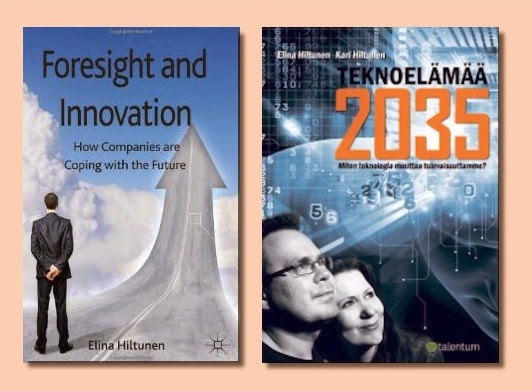
Technolife 2035: The English-language version of Teknoelämää 2035 by Finnish futurists Elina and Kari Hiltunen is now in progress and should be available soon. Elina’s previous book, Foresight and Innovation: How Companies are Coping with the Future, available in both Finnish and English, offers unique foresight tools that she has developed, such as the TrendWiki, Futures Windows, Strategic Serendipity, and the Futuropoly board game. Details 
Earth Policy Institute to Close: Leading environmental policy expert Lester R. Brown has announced his plans to retire from the think tank he founded in 2001. EPI will close by July this year, and the English-language versions of its principal publications will be housed at Rutgers University, Brown’s alma mater, in the new Lester R. Brown Reading Room. Brown’s career, spanning more than half a century, was devoted to measuring the planet’s resources and assessing its well-being, and issuing urgent warnings on such problems as climate change, overpopulation, and unsustainable consumption of resources. Details 


Frances Segraves, Former Futurist Staff Editor: We sadly report the passing of our friend and former colleague, pioneering newspaper journalist Frances Segraves, on January 14. She was 87. Frances was a staff editor for The Futurist magazine and the World Future Society Bulletin, retiring at the end of 1998. Before joining WFS to work with her longtime friends Ed and Sally Cornish, Frances was one of the first female reporters in the 1950s to cover hard news stories, working for The Frederick News, The Baltimore Sun, Bethlehem Globe-Times, and The Washington Star. She was also an activist in the anti-war and civil rights movements in the 1960s and 1970s. Details 


Send us your signals! News about your work and other tips are welcome. Contact Cynthia G. Wagner, consulting editor.  

Want more signals from AAI Foresight? Check out the blog! Log in to add comments.

Feel free to share Foresight SIGNALS with your networks and to submit any stories, tips, or “signals” of trends emerging on the horizon that we can share with other stakeholders and the foresight community. And if you’re interested in becoming a blogger for FS, please contact Cindy Wagner, our consulting editor, at CynthiaGWagner@gmail.com


Foresight SIGNALS is a publication of AAI Foresight

1619 Main Street #1172
Freeland, WA 98249

Managing Principal: Timothy C. Mack
tcmack333@gmail.com | 202-431-1652

Webmaster and IT Consultant: Tom Warner

Consulting Editor: Cynthia G. Wagner


Friday, January 23, 2015

The Legal Nightmares of Self-Driving Cars

By Timothy C. Mack

The auto industry is clearly convinced that the question of autonomous vehicles is “not if, but when,” writes Motor Trend technical director Frank Markus, reporting from a forum on Intelligent Transportation Systems in Detroit. Lux Research projects $87 billion in revenues by 2030. But the view is not so clear concerning how the longstanding legal guidelines around automotive liability will be affected.

Markus notes a number of relatively clear benefits of a working national system, such as reducing accidents by potentially as much as 95%, according to Bryant Walker Smith of the University of South Carolina law school. Other benefits: increased mobility for nondrivers, reduced fuel consumption, and intelligent driving patterns.  On the other side of the coin, intelligent transportation systems could increase road use and congestion, reduce public transportation usage, and create an economic slump in, for example, auto repair services.

But one of the most interesting questions regards the sharing of roadways between autonomous and driver-controlled vehicles: If there are far fewer accidents, there will still be accidents, but probably fewer insurers to cover them. Who is responsible when accidents happen? Who pays? Rather than owners of autonomous vehicles taking out insurance (and paying premiums), would it fall on manufacturers to indemnify their products?

One possibility is public/private special compensation funds to underwrite unintended consequences, such as how AI chooses to mitigate damage in an unavoidable accident. Owners of older, non-autonomous cars might be required to financially subsidize the rollout of presumably safer autonomous vehicles and road systems. Of course, manufacturers’ liability remains a toss-up in any court of law.

However, Markus reports, the RAND Corporation’s James Anderson and the Brookings Institution have both cautioned about proactively resolving liability issues through legislation without longitudinal experience to rely upon because, as Anderson has said, “we get such legislation wrong a lot.” 

Timothy C. Mack is the managing principal of AAI Foresight.

Image credits: Google, Sam Churchill


Tuesday, January 13, 2015

Signals: Bamboo Bike... Charitable Incentives... Futurists At Work... and more

Vol. 1, No. 6 | January 15, 2015 | AAI Foresight

Inside Foresight SIGNALS

> Power Pedaling with Bamboo Bike
> Philanthropy and Productivity
> Why Some Fossil Fuels Need to Stay in the Ground
> Book Note: Toward a Freakier Mind-Set
> Futurists at Work, Foresight in the News

Power Pedaling with Bamboo Bike


A bamboo bicycle under development in Mexico promises to be tougher, lighter, and less prone to heat, and thus an innovative way to replace metal parts with natural materials. But wait, there’s more: The bamboo bike will also generate energy.

Pedaling a bike creates kinetic energy, so the goal of the Bambootec consortium is to capture that energy through circuits in the rims and run it to converters and regulators in the system’s core under the seat. The energy is converted to electricity—about 10 volts—which can recharge mobile devices and a smartphone battery, and power a navigation dashboard on the handlebars, connected via Bluetooth.

The team’s goals now are to accelerate the charging process and to develop the machinery to scale the bamboo bike up for mass production. Bambootec, located in Yucatán, is a participant in Cleantech Challenge Mexico, a contest that promotes the development of green enterprises.

Source: Investigación y Desarrollo [in Spanish].

Signals: appropriate technology, bicycles, green energy, Mexico, renewable resources, sustainability, transportation


Philanthropy and Productivity


Encouraging workers to give at the office may turn out to be a good way to boost their productivity. A study at Britain’s University of Southampton found that, when subjects could choose the amount of performance-based pay they would share with charity, their performance increased considerably.

“A lot of studies have shown how financial incentives, like bonuses and stock options, can improve performance,” said the study’s lead author, University of Southampton economist Mirco Tonin, in a press statement. “But our results provide empirical support for the growing recognition that some workers are also motivated by advancing social causes through their efforts.”

While financial incentives like bonuses are still more effective at motivating workers, the difference is not as wide as many believe, suggests the study, to be published in Management Science. Tonin concludes that “firms willing to introduce corporate giving programs may want to consider giving employees the opportunity to ‘opt in.’”

Reference: “Corporate Philanthropy and Productivity: Evidence from an Online Real Effort Experiment,” Mirco Tonin and Michael Vlassopoulos, Management Science, DOI: 10.1287/mnsc.2014.1985

Signals: business, philanthropy, productivity


Why Some Fossil Fuels Need to Stay in the Ground


A large portion of the world’s untapped coal, oil, and natural gas needs to stay in the ground through 2050 in order to keep global warming from exceeding the internationally agreed limit of 2°C, warns a new study from University College London’s Institute for Sustainable Resources.

The study, published in the journal Nature, recommends that the Middle East leave 65% of its gas in the ground, and that 80% of the coal in China, Russia, and the United States remain undisturbed through the next 35 years, along with 260 billion barrels of petroleum reserves—the equivalent of all of Saudi Arabia’s oil reserves.

How do we avoid either an economic catastrophe or an environmental one? Energy companies (and their investors) should divert the search for more fossil fuels to more alternatives, according to the study’s co-author, environmental policy professor Paul Ekins.

“The greater global attention to climate policy … means that fossil fuel companies are becoming increasingly risky for investors in terms of the delivery of long-term returns,”says Ekins. “I would expect prudent investors in energy to shift increasingly towards low-carbon energy sources.”

Reference: C. McGlade and P. Ekins, “The geographical distribution of fossil fuels unused when limiting global warming to 2°C,” Nature (January 7, 2015). DOI: 10.1038/nature14016 

Signals: climate change, energy, fossil fuels, global warming, low-carbon fuels

Book Note: Toward a Freakier Mind-Set


Finding and interpreting signals or outliers in the landscape is part of the job for foresight professionals. It requires us to think differently about what we see, and even about what we seek, which may be why many of us self-identify as geeks or freaks.

In Think Like a Freak (Morrow, 2014), University of Chicago economist Steven D. Levitt and journalist Stephen J. Dubner share techniques for training your mind to think differently, a prerequisite for foresight.

The process is both rewarding and humbling. Why “humbling”? Because you’ll need to learn to say “I don’t know” more often (faking it could have higher social consequences), to think about problems as a child would (ask naïve questions; break things into smaller bits), and to permit yourself to quit when your efforts are futile: Let it go.

Think Like a Freak is well-populated with case studies for freaky thinking in business, which should prove of value to futurists and foresight professionals working with business trends and clients.

Excerpted from Foresight SIGNALS Blog. Read the review.  More information.

Signals: business, creative thinking, Freakonomics, futurist methodologies, strategies, trends


Futurists at Work, Foresight in the News


Islam, Islamism, and Islamaphobia: “We have to liberate ourselves from the phobia of being accused of Islamaphobia,” strategic futurist Tsvi Bisk told Israeli television i24 News, responding to a series of lone-wolf terror attacks in France in December. The war, he said, is not on terrorism, which he described as a strategy (like a flanking maneuver), nor on Islam, but rather on Islamism—“a totalitarian ideology whose aim is to conquer the world.” However, he continued, “that does not mean one iota that you tolerate discrimination against law-abiding Muslims. In other words, it’s a two-pronged attack. You respect and integrate law-abiding Muslims and you uncompromisingly fight against radical Islamism. I don’t see why that’s such a crazy thing to think about.” Watch the interview. Contact Tsvi Bisk, Center for Strategic Futurist Thinking.


Futurist in Government: Bulgarian futures researcher and strategic planner Mariana Todorova is now a Member of Parliament, joining the National Assembly of the Republic of Bulgaria in November 2014. She previously served as an adviser to the president (2008-2014) and now has joined the Parliament’s committees for Education and Science and for Labor, Social, and Demographic Policy. Formerly an assistant professor at the Bulgarian Academy of Sciences, she has worked toward developing a new methodology of scientific forecasting that combines counterfactual analysis and scenario building. Details. 

Redrawing the Global Language Map: A new, omnidisciplinary look at the present state and future of language is being planned by University of Kentucky geographer Stanley D. Brunn. The multivolume collection, tentatively titled The Changing World Language Map, proposes to cover the intersection of language and geography, with chapters contributed by scholars from all over the world and from different backgrounds. Scholars interested in contributing should contact Dr. Brunn at Brunn@uky.edu

Signal of the Month: Trees and Housing. In his monthly e-newsletter, financial adviser and futurist James Lee offers several wise tips for your 2015 financial resolutions; number 7 is saving for a new home. If your goal is to move to a better, safer neighborhood, Lee recommends going to Google Maps and looking for neighborhoods with more trees. “This is simple, but it works!” he writes in his January 9 newsletter for StratFi, The Forward View. Sign up for the free monthly e-newsletter at StratFi. 


Send us your signals! News about your work or other tips are welcome. Contact Cynthia G. Wagner, consulting editor.  

Want more signals from AAI Foresight? Check out the blog! Log in to add comments.

Feel free to share Foresight SIGNALS with your networks and to submit any stories, tips, or “signals” of trends emerging on the horizon that we can share with other stakeholders and the foresight community. And if you’re interested in becoming a blogger for FS, please contact Cindy Wagner, our consulting editor, at CynthiaGWagner@gmail.com


Foresight SIGNALS is a publication of AAI Foresight

1619 Main Street #1172
Freeland, WA 98249

Managing Principal: Timothy C. Mack
tcmack333@gmail.com | 202-431-1652

Webmaster and IT Consultant: Tom Warner

Consulting Editor: Cynthia G. Wagner


Sunday, January 11, 2015

Review: Think Like a Freak

Toward a Freakier Mind-Set


Finding and interpreting signals or outliers in the landscape is not simply a matter of visual prowess, but of thinking differently about what is seen or even sought. It is part of the job for foresight professionals, which may be why many of us self-identify as geeks or freaks.

The authors of Freakonomics (2005) and SuperFreakonomics (2011) now share techniques for training your mind to think differently, a prerequisite for foresight. The process is at first humbling, then rewarding, promise University of Chicago economist Steven D. Levitt and journalist Stephen J. Dubner.

Why humbling? Because one of the first things that anyone doing any kind of research needs to be able to say is “I don’t know.” And it is this very phrase that most professionals are reluctant to utter, whether to a supervisor, a client, or a child.

“That’s a shame,” write Levitt and Dubner, “for until you can admit what you don’t yet know, it’s virtually impossible to learn what you need to.”

Forecasters who rely on extrapolating trends into the future, without regard to alternative possibilities, may simply be bluffing—or, worse, imposing their own dogma onto the projected landscape, the authors warn. But which is worse, admitting up front that you don’t know, or ultimately being proven wrong? As in the case of Iraq’s possession (or not) of weapons of mass destruction, sometimes “the societal costs of faking it can be huge,” the authors note.

Another humbling technique for freakier thinking is to think as a child would. Magicians know that children are harder to trick than grownups are, because magic, or illusion, is based on diverting the audience’s attention with social cues: When they point to the hand that does not have the ball, grownups follow the cue while children follow the ball. As grownups, we need to unlearn some of these social cues in order to think like a freak—er, child.

Childlike thinking also involves breaking down big problems into smaller ones. For instance, with the big problem of improving academic achievement, the big, grownup solution is to overhaul education systems. But as Levitt and Dubner point out, “One in four children, it turns out, has subpar eyesight, while a whopping 60 percent of ‘problem learners’ have trouble seeing.” So a smaller solution to our big problem might be to improve vision screening.

Think Like a Freak is well-populated with case studies for freaky thinking in business, which should prove of value to futurists and foresight professionals working with business trends and clients. Much of this relates to developing persuasiveness, clearly a key trait to success in any endeavor.

Finding the right incentives, for instance, has enabled Zappos, the online shoe sales company, to attract outstanding talent to its team and give customers more than an easy way to buy shoes. What Zappos offers customers besides shoes, according to Levitt and Dubner, is friendliness, turning its customer representatives into talk therapists.

Wouldn’t that cost more? Rather than higher salaries, Zappos offers its reps more power, more authority to resolve customers’ problems; it also makes work more fun.

“Thinking like a freak may sometimes sound like an exercise in using clever means to get exactly what you want, and there’s nothing wrong with that,” the authors write. But “the best way to get what you want is to treat other people with decency. Decency can push almost any interaction into the cooperative frame.”

Persuading those who do not want to be persuaded is another tough act of freaky thinking. For example, not everyone buys into the trendy idea that Driverless cars are the future! Clearly, professional drivers whose jobs would be in jeopardy are not persuaded about this vision, nor are environmentalists who foresee more cars being put on the roads, exacerbating congestion and pollution. But rather than insulting such critics, calling them luddites, proponents of driverless cars should acknowledge the strength of the arguments, Levitt and Dubner suggest.

Finally, the bravest act of freaky thinking may very well be admitting failure. We certainly value fortitude and determination, but not obsessiveness in the face of futility. Quitting isn’t failure, the authors remind us; failing is failure. The upside to quitting—to recognizing a brick wall before you hit it—is reserving resources and resilience for finding a way around, over, or even under that brick wall.

“Think about all the time, brain power, and social or political capital you continued to spend on some commitment only because you didn’t like the idea of quitting,” write Levitt and Dubner. “Resources are not infinite: you cannot solve tomorrow’s problem if you aren’t willing to abandon today’s dud.”

Of course, we don’t want future Edisons to abandon their light bulbs before they get to the eleven-thousand-and-first experiment that finally succeeds. So how do you predict failure before it happens? One freaky idea is to use “pre-mortem” (as opposed to post-mortem) analysis, in the terminology of psychologist Gary Klein, offering team members on a project the opportunity to (anonymously) imagine everything that could go wrong and the reasons behind a potential failure.

And if the word “quitting” still unnerves you, borrow the currently popular girls’ anthem from Frozen: “Let it go.”

Basically, thinking like a freak is about thinking “a bit differently, a bit harder, a bit more freely,” write Levitt and Dubner. And these are activities we surely ought not to quit.


Cynthia G. Wagner  (@CynWag1)  is the consulting editor of Foresight SIGNALS.

Photos via Amazon.com authors’ pages.

Wednesday, December 31, 2014

Signals: Cybermurder... City Night Lights... 24th Century Medicine... and more

Vol. 1, No. 5 | January 2, 2015 | AAI Foresight

Inside Foresight SIGNALS


> Has the First Cybermurder Already Happened?
> Satellites Reveal a Global Night-Light Gap
> Boldly Forecasting Emergency Medicine in the 24th Century
> Rooftop Resources Project: Report from Timothy Mack
> Futurists at Work, Foresight in the News

Has the First Cybermurder Already Happened?


The recent spate of attacks ranging from corporate theft to denial of service for gamers has brought new attention to cyberwarfare and cybercrime. The potential for even online murder was one of the forecasts by the Internet Organized Crime Threat Assessment (iOCTA) report. But it’s possible that a cybermurder has already taken place, observes foresight analyst Richard Yonck in his recent post on the Scientific American blog. 


“When hackers cause widespread power outages as they may have done in Brazil nearly a decade ago,” Yonck writes, “isn’t it likely that someone among the millions affected will die due to a lack of electricity? True, such deaths wouldn’t have been specifically targeted, but to any victims and their families that distinction is of little comfort.”

FBI futurist Marc Goodman, author of the forthcoming Future Crimes, adds that even six years ago, “terrorists were using search engines, like Google, to determine who shall live and who shall die,” as he recently noted on Tim Ferriss’s podcast. And technologies that can do more damage are now in more hands: 3-D printers can produce military weapons and bioterrorists can download the recipes for diseases from the Internet.

Indeed, the biggest potential threat from cybercrime is how easy it is becoming for more people to commit it, Yonck argues. We should therefore “give greater consideration to the negative and unanticipated consequences of our new technologies as early in their development as we possibly can, in order to better address their vulnerabilities and shortcomings,” he advises.

And Goodman reminds us that we can do more to protect ourselves from cybercrimes by using common sense: For instance, don’t open links or attachments in e-mails from unknown sources, keep your security software up to date, don’t use the same user names and passwords for all your accounts, and invest in a subscription to a virtual private network if you frequently use public Wi-Fi.

Sources: “Facing Up to Online Murder and Other Cybercrimes” by Richard Yonck, Scientific American Blog (December 3, 2014). “Marc Goodman, FBI Futurist, on High-Tech Crime and How to Protect Yourself,” The Tim Ferriss Show (podcast, December 9, 2014).

Image credits: Surian Soosay (Internet riot police), Tim Reckmann (Anonymous), via Flickr, Creative Commons. Collage by C. G. Wagner for AAI Foresight SIGNALS.

Signals: bioterrorism, cybercrime, hackers, security


Satellites Reveal a Global Night-Light Gap


Not only are American cities brighter at night than German cities are, but the night-light gap actually increases with city size: Larger U.S. cities emit more nighttime light per capita than smaller cities do, while larger German cities emit less.


These findings are the product of new high-resolution night imaging made possible by the European Space Agency’s NightPod instrument, deployed in 2012. Work conducted by the Remote Sensing section of the German Research Center for Geosciences also reveals significant differences in the world’s light sources: Airports and harbors generate most of the night light in megacities of the developing world, while sports stadiums and leisure centers light up the night in wealthier cities of Europe.

The brighter lights of bigger U.S. cities may be due to differences in the types of lamps used, in the architectural features of the cities, or in the amount of trees or other foliage available to block light traveling upward.


The findings also offer data on electricity use and suggest ways to improve lighting efficiency in the world’s cities: Installation of efficient LED lamps, for instance, could reduce future consumption—and minimize light pollution by directing less light upward into the night sky.


Reference:  C.C.M. Kyba, S. Garz, H. Kuechly, A. Sánchez de Miguel, J. Zamorano, F. Hölker (2015). “High-resolution imagery of Earth at Night: new sources, opportunities, and challenges.” Remote Sensing, 2015, 7(1), 1-23; doi:10.3390/rs70100001

Signals: astronomy, cities, efficiency, energy, imaging


Boldly Forecasting Emergency Medicine in the 24th Century


Humans will be living longer and healthier lives three centuries from now—at least until we’re called into battle against Klingons.

The 50-year-old Star Trek science-fiction franchise has inspired numerous innovations, from fax machines to flat-screen monitors. Now, a team of scholars in Vienna is speculating on how emergency medicine may evolve by analyzing more than 500 episodes from the various Star Trek series.

We’ll still die from cardiac arrests in the future, according to study leader David Hörburger of MedUni Vienna, but the causes will be more related to traumatic events, such as exposure to “energy weapons” and poisoning, rather than to general medical problems, such as arrhythmias.

The study also offers guidance for treatment of cardiac arrests; today, patients have a better chance of survival if they are already in the hospital, while those home alone have the worst survival rates. By contrast, cardiac arrest patients in Star Trek’s twenty-fourth century benefit from teleportation and the hand-held diagnostic “tricorder” device—fictional inventions that are already inspiring today’s medical innovators.


Reference: D. Hörburger, J. Haslinger, H. Bickel, N. Graf, A. Schober, C. Testori, C. Weiser, F. Sterz, M. Haugk. (2014). “Where no guideline has gone before: Retrospective analysis of resuscitation in the 24th century.” Resuscitation (December: Volume 85, Issue 12, Pages 1790–1794) dx.doi.org/10.1016/j.resuscitation.2014.10.008.

Signals: health, medicine, science fiction, Star Trek

Rooftop Resources Project: Report from Timothy Mack


The practical realities of building sustainable networks are coming to life in Oakland, California, under the stewardship of a nonprofit group called Bay Localize as part of its Rooftop Resources Project.

Working with PlaceWorks, a Berkeley design and planning consultancy, Bay Localize is utilizing GIS tools to conduct a search for Green Roof candidates that might host hydroponic gardens, photovoltaic panels, and rainwater-collection systems. Some roofs could be viable for more than one of these uses, although slanted roofs have not worked well for garden sites. (Energy generation requires the slant to be in the right direction.)

The project team then collects a deeper layer of data on the ranges of building use and construction, roof access and materials, structural integrity, and surrounding room for ground-level water-collection tanks. This data can be collected and collated using hand-held devices and then used to calculate gallons of water, kilowatts of electricity, and pounds of vegetables potentially produced by any one rooftop. Read more.

Timothy Mack is the managing principal of AAI Foresight Inc. This report was excerpted from Foresight SIGNALS Blog. Image courtesy of Bay Localize.

Signals: collaboration, energy, gardens, green buildings, hydroponics, photovoltaics, sustainability, urban planning, water

Futurists at Work, Foresight in the News


Sci-Fi Author Named Chief Futurist: Magic Leap Inc. has tapped science-fiction author Neal Stephenson, who coined the concept of the “metaverse,” to help develop the technologies behind the company’s products, largely related to games and how users experience artificial worlds. “Neal is a true visionary and the very first to conceptualize a social, virtual world in a coherent way,” said Magic Leap founder, president, and CEO Rony Abovitz  in a press release. Stephenson responded wryly on the company’s blog: “‘Chief Futurist’ runs the risk of being a disembodied brain on a stick. I took the job on the understanding that I would have the opportunity to get a few things done.”

The Futurist Portfolio: South African investment banker Murray Legg believes U.S. companies will continue their momentum in 2015, with technology, health care, and industry delivering “great returns, likely into the low double digits,” he writes on his blog. His Futurist Portfolio comprises companies led by visionaries, “companies that are looking into the future and bringing solutions to market that address the challenges the middle of the bell curve aren’t entirely aware of as yet.” His picks include Naspers, Novo Nordisk, Google, Apple, Alibaba, Tesla, and Airbus. Read: “2015—My Stock Portfolio View,” Murray’s Blog (December 6, 2014).

A Futurist for the Birds? Environmental scientist Jessica Zelt’s work enlisting citizen scientists to produce a database of bird sightings is featured in Audubon magazine. Begun in 2008, the project to digitize the North American Bird Phenology Program now involves more than 2,500 volunteers transcribing handwritten reports as much as 100 years old. Unlocking this historic data promises to help scientists understand the effects of climate change on bird migration. Read: “Three Generations of Citizen Science: The Futurist” by Rachel Nuwer, Audubon (November-December 2014).


Send us your signals and stories! News about your work or other leads, tips, reviews, and ideas are welcome. Contact Cynthia G. Wagner, consulting editor.


Want more signals from AAI Foresight? Check out the blog! Log in to add comments.

Feel free to share Foresight SIGNALS with your networks and to submit any stories, tips, or “signals” of trends emerging on the horizon that we can share with other stakeholders and the foresight community. And if you’re interested in becoming a blogger for FS, please contact Cindy Wagner, our consulting editor, at CynthiaGWagner@gmail.com

Foresight SIGNALS is a publication of AAI Foresight

 1619 Main Street #1172
Freeland, WA 98249

Managing Principal: Timothy C. Mack
tcmack333@gmail.com | 202-431-1652

Webmaster and IT Consultant: Tom Warner

Consulting Editor: Cynthia G. Wagner


Building Sustainable Networks: Rooftop Resources Project

By Timothy C. Mack

The practical realities of building sustainable networks are coming to life in Oakland, California, under the stewardship of a nonprofit group called Bay Localize as part of its Rooftop Resources Project.

As a builder of engagement networks, this nonprofit partners with city governments and local communities to assess resources and meet sustainability challenges. These challenges include mitigating the effects of climate instability and energy costs while equipping local leaders with tools and models that are flexible enough to use in a variety of settings. 

Working with PlaceWorks, a Berkeley design and planning consultancy, Bay Localize is utilizing GIS tools to conduct a search for Green Roof candidates that might host hydroponic gardens, photovoltaic panels, and rainwater-collection systems. Some roofs could be viable for more than one of these uses, although slanted roofs have not worked well for garden sites. (Energy generation requires the slant to be in the right direction.)

The project team then collects a deeper layer of data on the ranges of building use and construction, roof access and materials, structural integrity, and surrounding room for ground-level water-collection tanks. This data can be collected and collated using hand-held devices and then used to calculate gallons of water, kilowatts of electricity, and pounds of vegetables potentially produced by any one rooftop.

Concerning food production, hydroponics is showing promise as a strategy to lower roof load; rainwater harvesting usually requires room for at least a 1,000-gallon cistern. After initial assessments, built using a data-management tool known as ArcGIS, the project estimated potential yields of at least 25% of the total power usage of the neighborhood under study and more than enough food production to meet the needs of the 7,000 people living there.

This PlaceWorks approach has been recognized for its potential by the American Planning Association, American Society of Landscape Architects, and Association of Environmental Professionals.

Timothy Mack is the Managing Principal of AAI Foresight Inc. This post originally appeared on the AAI Foresight Blog.

Sunday, December 14, 2014

Signals: Peak Youth... Fish Forecasting... Rise and Fall of Intelligence... and more


Vol. 1, No. 4 | December 15, 2014 | AAI Foresight 

Inside Foresight SIGNALS

> Peak Youth: Preparing Now for an Aging Planet
> Fish Forecasting: New Methods for Monitoring Marine Life
> Book Note: The Rise and Fall of Intelligence
> Signals from the Foresight Community

Peak Youth: Preparing Now for an Aging Planet

The majority of countries around the world are graying, due to the so-called demographic dividend: Improved educational attainment and economic empowerment are lowering birthrates, and individuals are living longer, healthier lives.

As a result, we may soon reach “peak youth,” wherein the number and proportion of young people in the world are as high as they will ever be. Without investment in their futures, these young people could be burdens to society rather than assets, warns a new report from the UN Population Fund (UNFPA).

There are currently 1.8 billion humans ages 10 to 24, but those numbers are expected to drop as more countries benefit from the demographic dividend. Only six countries, five of which are in sub-Saharan Africa, are “youthening” rather than aging, but even these countries are expected to reverse the trend by 2020.


For societies to benefit from the demographic dividend, young people need opportunities to thrive; this means not just creating jobs for them, but also improving education and health, especially for girls, the report urges.

The time to make these investments in youth is now, UNFPA report editor Richard Kollodge told IRIN News: “Eventually a very young population will become a very old population, and you have to plan for that too. Unless steps are taken right now, then the opportunity for a demographic dividend will be squandered.”


Signals: aging, birthrates, development, education, health, population, youth


Fish Forecasting: New Methods for Monitoring Marine Life

The cold waters off Peru and Chile are richly productive, yielding between 5% and 10% of the world’s fish. Researchers are now learning more about why this ecosystem, known as the Humboldt Current, is so productive, aiming to predict the impacts of environmental disturbances on these waters’ productivity.

Life in the Humboldt Current is nourished by the constant upwelling of more nutrient-rich waters from the deep, according to researchers from the Institute of Research for Development (IRD) in France. Using high-resolution sensors, they have modeled the circulation of oxygen content in these churning waters, monitoring how variations in the intensity of seasonal, low-oxygen currents from the equator affect the Humboldt’s ecosystem.

With additional modeling work, these studies will help improve forecasts of the health of important fish resources, particularly anchovy stocks.

Bioluminescence—the flashes of light generated by tiny marine organisms such as dinoflagellates—offers another unique tool for monitoring fish stocks, believes Dr. Charlotte Marcinko of Britain’s National Oceanography Centre. When fish move through the seas, the churning water disturbs the dinoflagellates and triggers the chemical reactions producing the telltale glow.


Modeling changes in the seasonal abundance of the bioluminescent organisms may better inform researchers monitoring the size and movements of fish populations.


Signals: ecosystems, fish, models, oceans, resources


Book Note: The Rise and Fall of Intelligence

Defense Department historian Michael Warner’s timely book The Rise and Fall of Intelligence: An International Security History (Georgetown University Press, 2014) offers an academic but accessible overview of a topic naturally veiled in secrecy and cloaked in misconceptions. The author eschews sensationalism, unlike the still-trending reactions to reactions to the so-called #TortureReport recently released by the Senate Select Committee on Intelligence (Executive Summary: PDF).


In fact, the details and findings of the SSCI report ought not to be a surprise, as the CIA inspector general’s own review of the “enhanced interrogation program,” which occurred at about the same time that the Abu Ghraib prisoner abuse scandal broke, was stomach-turning (and policy-questioning) in its own right: “Not a few American officials believed the legal rationale for those techniques could not be defended,” Warner writes.

Historically, what Warner refers to as the rise of intelligence is the long-term professionalizing of the endeavors of states … to advance or protect their own interests—vital for preventing wars or winning them efficiently. …

Now, the Information Revolution has generated vastly more intelligence and more entities anxious to use or abuse it, while overwhelming analysts. “The digital revolution compounded the [analysis] problem many times over,” Warner writes. Today, we are seeing the fall of intelligence and perhaps the end of secrets.

Adapted from Foresight SIGNALS Blog. Read the review. Purchase the book. 

Signals: governance, information, intelligence, security, torture, war, world affairs


Signals from the Foresight Community

Association of Professional Futurists: Nominations for Most Significant Futures Work for 2015 are open until January 31, 2015. The awards recognize the work of foresight professionals and others engaged in advancing our understanding of the future. The work may be text (e.g., books, dissertations, reports) or digital (Web sites, games, videos, software), produced between 2010 and the end of 2014. Winners will be announced at the APF Annual Reception in San Francisco on Saturday, July 25, 2015. Details: APF (Signal via Andy Hines) 

International Society for Information Studies: Call for papers— "The Global Brain and the Future Information Society," part of the IS4IS 2015 Summit Vienna to be held at the Vienna University of Technology, June 3-7, 2015. Featuring keynote speaker Francis Heylighen, director of the Global Brain Institute, the track aims to cover the multifaceted impacts of information technology on society. One-page abstracts with links and references should be submitted by February 15, 2015, through the conference submission page. Details: IS4IS 2015 Summit Vienna (Signal via Francis Heylighen)

Club of Amsterdam: The Future Now Show is a monthly video series exploring current affairs and the visions they inspire, and sparking discussions for strategies to shape the future. Recent webisodes have covered changing universities, political transition in the Middle East and North Africa, 3-D printing and medicine, climate change and food, and more. Tune in: The Future Now Show (Signal via Felix Bopp) 

Gordon Report: Despite an encouraging figure of 5.8% unemployment in the United States, all is not well for either job seekers or employers, according to the December 2014 issue of Imperial Consulting Corporation’s monthly newsletter. The official unemployment figure does not include individuals working part time but hoping for full-time jobs with benefits, nor those who have become too discouraged to continue seeking work. Meanwhile, employers are struggling to find workers with the high-level skills they need. This is a problem that employers may need to address more aggressively themselves by investing in training. Learn more or subscribe: Gordon Report (Signal via Edward Gordon) 

Send us your signals! News about your work or other leads, tips, and ideas are welcome. Contact Cynthia G. Wagner, consulting editor. 


Want more signals from AAI Foresight? Check out the blog! Log in to add comments.

Feel free to share Foresight SIGNALS with your networks and to submit any stories, tips, or “signals” of trends emerging on the horizon that we can share with other stakeholders and the foresight community. And if you’re interested in becoming a blogger for FS, please contact Cindy Wagner, our consulting editor, at CynthiaGWagner@gmail.com


Foresight SIGNALS is a publication of AAI Foresight

1619 Main Street #1172
Freeland, WA 98249

Managing Principal: Timothy C. Mack
tcmack333@gmail.com | 202-431-1652

Webmaster and IT Consultant: Tom Warner

Consulting Editor: Cynthia G. Wagner